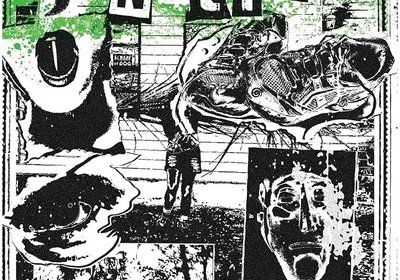
Yeehaw Junction
Monstruck Books, Nov 2025
Yeehaw Junction, Florida, is toxic.
Brain-eating amoebas, white trash, and grotesque Americana pool in the dark nooks and crannies of Kayli Schloz’s third novel, Yeehaw Junction. Where else but Florida? The soil itself seems complicit. Even the sunlight is hostile. Damage piles up faster than it can be repaired.
Rooted squarely in the Y2K era and the infancy of the internet—shadowed by Columbine, Woodstock ’99, and a culture only beginning to understand the chokehold of spectacle—Yeehaw Junction is a blistering account of how attention becomes a dangerous commodity. Who gets it and at what cost? Though the novel takes place in 1999, it isn’t interested in pure nostalgia. It reads instead like an origin story, whose consequences are still unfolding. This is a book about wanting to be noticed in a culture that only looks when something is on fire. Or bleeding. Or dead.
The novel pulls no punches, opening with an epigraph from Florida’s own serial killer extraordinaire, Aileen Wuornos: “Thanks a lot, society, for railroading my ass.” From the opening page, the book blatantly announces its terms. Blame and responsibility will not be handled gently. Violence here is not a mystery, it is the predictable output of a system that neglects, poisons, and exploits—then feeds on the fallout.
Yeehaw Junction doesn’t explain this so much as perform it, implicating the reader in the act of watching. Our guide through this wasteland is Skeet, a twelve-year-old Marilyn Manson superfan, wannabe school shooter, and entrepreneurial hustler. Skeet sells jars of Florida soil polluted with DDT, pitching them to tourists as “a piece of Florida history.” He lives in a house full of castoffs, presided over by Trudy, a matronly stripper and specialty fetish model of transgressive content on the dark web. Skeet’s closest companion is Cricket, a forty-three-year-old incest survivor, whose trauma has shaped her into a perpetual state of arrested development, anchored to a hysterical pregnancy.
Skeet and Cricket are always hustling to earn their keep, but money isn’t what they’re really after. What they want is something far more precious. Attention. Cricket seeks it through fantasies of motherhood; for Skeet, notoriety will do just fine:
It’s nice to get a little recognition once in a blue moon. Some people get recognition their whole lives. Every time they pump their fist, there’s somebody watching. Somebody looks and tells you you’re doing a great job—keep up the good work. I can count on a closed fist how many times somebody’s looked at me.
This craving curdles into fatalism. Skeet’s life is littered with petty crime, escalating violence, and the sense that nothing lasts long enough to matter anyway. When eleven-year-old Heather Studebaker goes missing, Skeet and his gang join the search not out of concern, but for the reward money. A hundred thousand dollars isn’t a welfare check. It’s a lottery ticket.
Sure, the whole state was looking for that eleven-year-old girl, but those people looking weren’t us. They didn’t know how to find the dirty rotten places where kids went missing. We did. We were rotten people and we came from a rotten place.
The search becomes the book’s forward motion. It is a bid for power that never holds, a way of marking their place in a world that has already written them off. Everything in Yeehaw Junction is antagonistic: the people, the water, the sun, the history baked into the land. And yet the book refuses easy villainy. After all, Yeehaw Junction insists that these terrible people come from somewhere. These lives are not aberrations. They are produced.
There’s generational damage here, an abandonment reinforced by poverty and abuse. Skeet traces his own origin story to a literal garbage can:
My story started in a trash can at Jacksonville General Hospital in the women’s emergency restroom. … The one from the mire. The muck stuck to me and I stayed muddy.
These are not outliers or mistakes. They are the surplus lives, shaped by neglect, then turned loose to live with the consequences. America doesn’t just fail them; it absorbs their damage and pretends it isn’t responsible for what comes next.
There are no heroes here, and no clean redemption arcs. Still, there are flashes of tenderness: moments of found family (however dysfunctional), acts of care and protectiveness that briefly hold the chaos at bay. But they never stop what’s coming. The book keeps escalating, pushing further into violence, until those fragile bonds are overwhelmed by the very system that produced them.
Yeehaw Junction is about the places where you’d rather not look. Dark corners and hidden desires, poisoned land and poisoned people. It’s about what happens when neglect becomes policy and attention becomes the only remaining proof of existence. This is the kind of book that knifes you in the stomach and leaves the blade there, suspended. It refuses to grant closure.
The message is blunt: this story isn’t finished. Just look around. Consider how fucked up things are now. Where do you think it all came from? We can’t even blame Marilyn Manson anymore.
Yeehaw Junction doesn’t let America look away. You can’t separate yourself from the environment that made you. Not the land. Not the systems. Not the violence.
Pay attention.

Brittany Micka-Foos is the author of the short story collection "It's No Fun Anymore" (Apprentice House Press, 2025) and the chapbook "a litany of words as fragile as window glass" (Bottlecap Press, 2024). Her work has been published in Ninth Letter, Witness, Epiphany, The Forge Literary, and elsewhere. Read more at www.brittanymickafoos.com.