Frayed Edges
Laura Davis
Femmesocial Press, Mar 2026
The first task of any reviewer is to identify what is being reviewed. Usually this is as simple as it sounds. Most work that comes across my desk belongs to recognizable genres or pre-established practices.
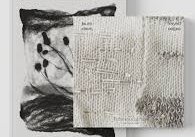
But such is not the case of Laura Davis’s Frayed Edges, which is unlike anything I’ve reviewed before. A two-volume set comprising a book of her poems with photographs accompanied by a book-length essay featuring contributions from other writers and artists, it explores textile poetry with an emphasis on the “primacy of process.” Davis’s essay also contains QR codes which link up to video performances. The poet works in conversation with a collective of artists to present an intriguing selection of overlapping media in which the material aspect is central to the poem itself.1
What, exactly, is “textile poetry?” Davis adopts an interrogative approach, asserting: “I am not attempting to define textile poetry, quite the opposite.” She begins with a question posed by SJ Fowler: “what would poetry look like if we used a needle and thread instead of pen and ink?” In contrast with the conventional invisibility of “pen and ink,” textile poetry is a more consciously concretized art. She observes:
“I do not investigate textile poetry as metaphor, in the sense of widely used textile-related linguistic metaphor (stories woven, truths embroidered, etc.), nor do I investigate page poems inscribed on fabric, even if many of the poems included here include words, or where the textile is purely illustrative. As Simon [Tyrrell] says, the interest in textile lies in its contribution to the materialisation of the work, not as a substrate for words. And, of course, not all textile art is poetry...”
Thus the book-length essay doesn’t serve as a manifesto (as in: “read it like this!”); rather, it provides useful context that will assist the act of reading and viewing, as other artists share their individual predilections and nuances in their conception of textile poetry, and how it searches for “fraying spaces for creativity.”
A representative example might be Davis’s “Signs on Leaves.” The text portion of the work uses five tercets and a quatrain, with classical allusion to The Aeneid and reference to contemporary political themes of the Anthropocene. Described this way, it sounds like something that falls within conventional formal parameters. It begins: “Her visions are clear when she wants to see / still tapestry scenes of all human fates.”
But then Davis turns to other processes, treating the text as only one ingredient of “Signs on Leaves.” She puts handwritten lines of the poem onto different papers and textiles, mounted onto bark. A film version, available on YouTube, adds image and voiceover effects while depicting the author in the act of working with the textile forms. The result is something altogether different from most poetry nowadays, not least because it takes the reader out of the usual text-centered comfort zone.
Similarly, a series called “Red Ghost” uses found materials such as leaves and autumn flowers, mounted on recycled linen, and incorporates “kneaded text” from Hardy’s The Return of the Native. In “Ariadne’s Bull,” the author applies a blow torch. The image of a bull’s head, with incorporated text, is changed irrevocably, but neither the “before” or “after” the torch is given primacy. Davis elaborates:
“A remarkable thing about a textile poem is that, often, all of the drafts are embedded in the work themselves; there is no equivalent, as Sylee [Gore] points out, to the endless invisible revisions that are possible in a Word document.”
Davis’s collaborators in the volume of essay approach the ambiguities of textile poetry from many different angles. Sylee Gore’s perspective is informed by the art of translation, while Rezia Wahid explores the use of thread and weaving based on Bangladeshi techniques. Simon Tyrrell sees textile poetry in light of folklore practices, and Julia Rose Lewis takes into account theoretical physics. Jules Sprake is interested in the uncompliant nature of materials that cannot be returned to their original form, and Susie Campbell focuses on decomposition, harnessing natural processes against the backdrop of environmental catastrophe. Imogen Reid and Campbell further emphasize the aspects of touch and smell of textiles, foregrounding the reader/viewer’s presence and participation.
There is often a theatrical element to many of these pieces, which the QR codes link to performances in the UK, Greece and Belgium. The Green Door Gallery in Brussels, curated by Irish artist Helen O’Sullivan-Tyrrell, has been an important venue for textile poetry events.
Frayed Edges is a heterogeneous, adventurous work that shows how much experimentation in poetry is still possible. Original and often surprising, it engages with tradition while offering something new.
1 Contributors from the UK, US, Germany, Bangladesh and Belgium include Susie Campbell, Sylee Gore, Julia Rose Lewis, Imogen Reid, Jules Sprake, Simon Tyrrell and Rezia Wahid. Laura Davis is British, and lived in Africa and the Middle East for many years before settling in Belgium.

Charles Holdefer’s new novel, Move the Mountain, will be published in 2027.