Casper has always been a wrong-way handshaker. He reaches too high, too low, too far to the right or left. At best, he gets fingertips, maybe a forearm. Most often, he misses entirely and squeezes thin air. By teen years, as handshaking became a more essential and expected greeting, Casper learned to play the problem off as a simple mistake, as if each time were the first time it’d ever happened. His strategy has changed little since then. With an awkward smile, he levels eyes down and readjusts, or simply allows his counterpart to forge the proper clasp—which typically sorts the matter—but today, Monday, November 6th, 2045, at the job interview, the only one he’s been able to wrangle in weeks, Casper’s usual remedy doesn’t work.
“What are you smiling about?” Mr. Lambert says, retrieving his unshaken hand from the empty space five inches above Casper’s depth-challenged paw.
“Oops, we missed there. Didn’t we?”
“We? What’re you blind? You nearly stuck it in my crotch. Unless you meant to grab my pecker?”
“Sorry, it was an accident.”
“Say that again.”
“Sorry?”
“Sorry? Is it a goddamn question?”
“No, it’s not a question, sir. Sorry about that.”
“Sorry about what?”
“That I mis-shook.”
“What’re you making up words now?”
“Sorry, Mr. Lambert. You’re right. I see your point.”
“Ok, now we’re getting somewhere.”
Behind Lambert’s thick, blotchy head, two tall potted plants capture Casper’s attention. They look real, but they also look plastic. They look plastic-real.
Real plants bred to look like plastic ones, Casper thinks. Or perhaps sprayed with a plastic coating so they don’t give off “the stench of impermanence” as his mother had often remarked of the withering and/or rotting things she’d kept in their living room when he was a boy; houseplants under or over watered depending on the state’s water allotment during a given month.
“I said, we’ll call if we’re interested,” Mr. Lambert repeats.
Casper exits the interview, embarrassedly replaying the mis-shake with Lambert, unsure if he got the job, unsure, even, of what the job is. On the bus ride back to his apartment, Casper takes a seat across the aisle from a young woman. A round-faced, full-lipped, dark-haired woman. The most beautiful woman who ever lived, he thinks, though this exact sentence comes to mind nearly every time he encounters an attractive woman. He squints and blinks, looks above and below the most beautiful woman who ever lived, but it’s no use. He’s staring.
“Sail the ship backward,” his ex-girlfriend, Miranda—if you can call someone you dated four times over videochat your girlfriend—used to tell him when he was “doing it again.”
The dark-haired beauty is younger, but similar in build to Miranda. At least what Casper imagines below-the-neck Miranda would look like. Firm breasts, narrow waist, large hips. As his eyes wander the woman’s body, a half-mast erection, like a Miranda mourning flag, begins to throb at his zipper. The woman turns toward him just now. Her large, green eyes are fresh and springlike. Nothing like the “all-consuming black holes” (another Miranda-ism) mounted in Casper’s skull. Back of the eye, root of the eye, he chants desperately, aiming his inner wind the-opposite-direction-of-forward, attempting to catch the ship’s sails and float his gaze toward a safer shore.
Moments later, peeking out from his embarrassment, Casper realizes the young woman’s eyes are not in any way aimed at him. That they are not at all concerned with his off-putting stare or wannabe woodie. Rather, they are fixed ninety degrees above his forehead, completely engrossed in something. It’s the sounds, Casper thinks. He tunes into them now, too. The ooohs and aaahs of heavy petting, the metallic tear of a zipper, and then . . .
“Oh, no!” A man groans.
“Don’t let this happen to you,” a deep voice warns. “Penetrate that poon with HARDIGANS.”
Casper wonders if the automatic advertisement somehow tuned into his thoughts, into his pants, but surely that’s not possible. The young woman giggles unabashedly, flashing large incisors with a delicate tongue pressing behind them. Casper inadvertently giggles too. He stares at her fully now, front eyes and all. The swelling throb behind his zipper is no longer a nuisance but a point of pride. Again, he wonders if it’s to do with the advertisement, if the ED meds somehow cascaded off the screen, poured into his fontanel, and dissolved into his bloodstream, causing a full wave of the penis flag. Casper’s first true erection since starting on Morosopram a year earlier.
“Next stop: Diversey and Damen.”
Committing to memory every curve and contour of the dark-haired beauty’s bod, Casper rises from his seat and meanders toward the exit, willing the erection to last all the way home, hoping to complete masturbation successfully today.
As the bus pulls away, Casper glances at the window where the woman sat. But it’s too late; his stiffy has already withered to its one-and-three-quarter-inch flaccid state. His head falls forward, empathetically following the lead of his phallus. With self-pleasuring off the agenda for the day, Casper lumbers across the intersection, his bulky work boots slapping the cracked pavement. Half a block later, arriving at building 13—a two-story brick row house in the Lathrop Homes housing projects—Casper aims a key at a deadbolt. He stabs new “miss marks” into his door as he tries and fails several times to enter the keyhole. It takes eleven full attempts before a successful insertion and lock-turning occurs. Stepping over the threshold of his one-room apartment, an alert bubble displays on his largescreen:
Advisory—level purple: NEWS dangerous for all groups.
When he last checked his smallscreen, no more than an hour ago, it was level orange, dangerous for sensitive groups only. Casper tries to imagine what horrific thing must’ve happened to spark a level purple.
As if sensing his reluctance to obey the advisory, the largescreen flashes another alert:
“No NEWS is good NEWS”—King James I of England.
“Fine, show me jobs,” Casper says.
The light on the largescreen softens to a warmer hue as it displays a page of want ads. Casper checkmarks the listings that interest him, even knowing they are likely to be scams:
Waiter—Nude Model—Life Coach
Closing his eyes, he pictures himself in each role. Nude model is somewhat more alluring than waiter, but then again, the issue of penis size. No, definitely not modeling, he decides. Of the three listings, there’s only one that truly captures Casper’s imagination. Miranda’s fault, no doubt. During their videochats, she would prattle on endlessly about her life coach, John Lynwood, frequently implying that Casper needed John’s guidance, too. It started on the very first date . . .
“You’re too slouchy. John says, ‘hoist your sails, take your balance’,” she said.
In a desperate attempt to correct his posture—not so much for himself, but for Miranda—Casper purchased the introductory portion of John Lynwood’s self-paced Mind Sailing™ program. He listened to Session One: Hoist Your Sails/Take Your Balance for hours each day. He listened to it in the mirror, straightening his slouch, committing to memory every syllable of John’s clever slogans in painstaking preparation for his next Miranda meeting. He listened to it even when he should’ve been looking for a new job. And so it was that when the day came, when the screen blipped on for their next video date, when Miranda’s perfectly round face came into view, Casper launched immediately into a clumsy recital of Mind Sailing™ catchphrases.
“You’re too outwardly focused. John says, ‘find your inner wind’,” she said.
Casper slouched forward. His mouth fell softly shut. His whole being drooped, like the sun setting at the end of a particularly short and dark day. Miranda had no trouble carrying the conversation from that point. Words spewed from her red lips so fast and furiously it seemed to Casper she was trying to eject them for all time. She talked about things she disliked: boring people, stupid people, old people, sick people, homeless people, and most of all “non-self-aware people.” She interjected many things about herself as well: favorite clothing brands, favorite workouts, favorite alcoholic drinks. Nothing too personal. She mentioned John Lynwood multiple times. Her admiration for him and his teachings. His positive energy and good looks. Casper waited for a gap in the monologue, a place where he could interject something not too “outwardly focused,” but none came. Unable to enter the conversation, and unsure even what to say should an opening occur, he grew more nervous by the moment. It wasn’t until the ten-second warning beeped, indicating the call’s impending close, that Casper took a leap. With only five seconds remaining, he fired off a mouthful of vows. He would buy session two of John Lynwood’s program. He would work harder on himself. He would become less outwardly focused before their next date. It was a relief the call clicked off before Miranda could reply.
Casper soon discovered that Session Two: Find Your Inner Wind cost twice the price of session one. It was more than he could afford. He bought it anyway. In the daily pursuit of self-correction, Casper sat before his hall mirror, hoisting sails, taking balance, searching for “inner wind”—but was never clear with himself whether he’d accomplished the techniques correctly or not. At the end of each session, he would click off the recordings and practice talking to Miranda-in-the-mirror, agreeing with her about John Lynwood’s positive energy and brilliant teachings.
Two weeks later, after several unsuccessful attempts to contact Miranda, Casper saw a frowny face turn smiley, the date-acceptance GIF, flashing on his smallscreen. When he clicked it, Miranda’s face appeared in the dating app window. Casper began to speak, then stopped, then began again. Miranda seemed busy, occupied with something other than their video date, but with face-only visibility—the app’s automatic setting—there was no telling what the rest of her was up to. Sitting unsteadily before her image, he wavered between hoisting sails and finding inner wind, unaware that the words “hoist sails” and “find inner wind” were slipping from his lips as he attempted the exercises.
“You’re too wishy-washy. John says, ’choose your course’,” Miranda said, hanging up just a few minutes into the call.
When Miranda’s image disappeared, when it was clear she wasn’t coming back, Casper understood what was expected of him. He returned to John Lynwood’s Life Coaching site, clicked on the Mind Sailing™ program, and purchased Session Three: Choose Your Course—no matter that it was, again, double the price of the previous session.
A week later, as he diligently practiced Mind Sailing™ in the hall mirror, something unusual happened to Casper. He found that John’s techniques and their intended results were becoming available to him. There was no doubt about it. He was actually choosing his own course! As if in response to Casper’s newfound abilities, Miranda accepted a fourth video date that very day. When she appeared on the smallscreen, Casper took the reins, inaugurating the conversation, speaking before Miranda had a chance. He said it was nice to see her and that she looked lovely. He told her about himself, about the great day he’d been having, about choosing his course. He described many details, including the fact that, just before the date, he’d sent his chatbot doctor a message, informing him that it was time to lower his daily dose of Morosopram. No sooner had the word Morosopram fallen from his lips than Miranda interrupted him.
“John would never take that poison,” she said.
Considering that he’d met Miranda on Down-with-Me™, the dating app for depressives, and knowing that she was on her own complicated cocktail of anti-downers, Casper didn’t take it too personally. Instead, he hoisted sails, took balance, found inner wind, and chose his next course. As he began telling her about his job, about his uniform and name tag, about how well-liked he was at work, she interrupted again.
“John’s job will never become obsolete,” she said.
It was true that Casper’s gig at Targazon—the last human-staffed warehouse in the entire Midwest—had gone from full-time to part-time to special events only, like major holidays and big sales. And it was true that his wages had become so meager as to barely cover rent on a subsidized apartment in the Lathrop Homes housing projects. But according to his boss, Roland, “Goober” (Casper’s nickname at work) was “a good worker, a solid worker.” Though the remark had been made only once, mumbled drunkenly at an office party, it gave Casper the hope of gaining more shifts, maybe even a raise.
As he contemplated his next course of action, the next words he would utter to Miranda, Casper was so internal, so non-outwardly focused, that a text bubbling on his smallscreen, a text from Roland, appeared as if in a dream. He read it aloud just as dreamily.
Yo Goober, sry to say, but you’re off the job. Feds have the info. Should see it on yer travel card any sec. Have a good one.
When he finished reading the text, he saw Miranda staring at him curiously through the smallscreen. It was the kind of stare someone gives when seeing a person or thing for the first time. Her lips began to tremble, peeling back into a grimace. A moment later, the video clicked off.
“Have a good one,” Casper repeated, savoring the moment of being seen.
When he realized her avatar had disappeared from the app, that she had blocked him from sending any more date invites, Casper lurched into the bathroom and popped a double dose of Morosopram. He lay in bed the rest of the day, staring at an image of her face, a lopsided and blurry screenshot he snuck on their first date. It was the only picture of Miranda he had. The following afternoon, he was still in bed, still with the picture. He lay there with his smallscreen, superimposing various bodies and clothes onto her face. He lay there, even knowing that he had a limited amount of time—the thirty-day unemployment grace period—before his travel card would downgrade him from Category One—Solid Citizen to Category Two—Conspicuous Person. It was four full days before he got up . . .
Now, as Casper’s eyes refocus on the largescreen, he discovers that the listings for Nude Model and Waiter have been replaced with the words: Position filled 11/6/45 4:56PM, Position filled 11/6/45 4:57PM.
But the Life Coach listing is still available! Never having met or even seen a life coach, Casper pictures John Lynwood donning athletic gear and a neck-lanyard whistle, waving arms and drilling team members like a sports coach.
Tweet, tweet. “Centerfield, choose your course!”
No, a more powerful whistle, Casper decides. One with a massive range—a pitch as high and thin as a dog whistle and deep and thick as a tugboat’s horn. With a whistle like that, Casper would be neither wishy-washy, nor depressed, nor obsolete. He clicks the More Information link.
Proper candidates will meet all criteria: education, special training, clean background, ability to guide, support, and hold clients accountable in all areas of “life.”
Casper chomps the inside of his cheek, considering the extent to which he meets the criteria. Though he has no formal education beyond high school, he does have three full installments of John Lynwood’s Mind Sailing™ method under his belt. And his background, other than a few childhood misadventures, episodes where he’d fought boys who pushed him one step too far, is more or less clean.
Like a mosquito zeroing in on warm flesh, Casper’s forefinger circles, hovers, and finally jabs the Apply Now link. Seconds later, a message pops up: Position filled 11/6/45 4:59PM.
“But it’s only 4:58,” Casper says, noting the time on his largescreen.
Before he can give it another thought, he hears his smallscreen buzzing along the tabletop. Casper answers immediately.
“This is Lambert. F.U. Services.”
“Hello, Mr. Lambert. So good to hear from you . . .”
“Can you start tomorrow?”
“Yes, definitely.”
“The address is 1048 South Prairie Blvd, Eastern Heights.”
“Wow, a couple long bus rides from me. But yes, sir. I’ll be there.”
“Eight sharp. When you get there, find the landline.” Click.
What the hell is a landline? Casper wonders.
The next morning, after a mile-plus walk from his second bus, Casper arrives at 1048 South Prairie, a single-story brick building in a former industrial area. An abandoned warehouse across the street is its only neighbor. Noting that many of 1048’s windows are covered in plywood, Casper double-checks the address before trying the door. He reaches for the knob, but misses by two inches. As he readjusts for another go, the door slowly automates open.
“Hello?” Casper yells into the dank darkness.
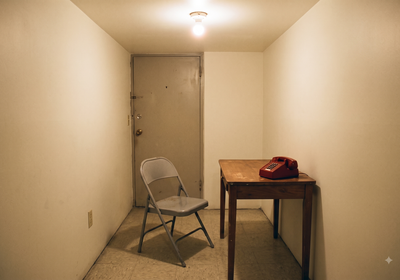
With no sign of human or artificial life within the large, open space, nothing to indicate how he should proceed, Casper turns to face the opposite side of the street. Two glassless windows, like empty eye sockets, stare back from the abandoned warehouse. The sudden vulnerability of being so alone in such an abandoned area causes him to jump through the door of 1048 and slam it behind him. He stands inside, gripping the doorknob tightly. As his eyes adjust to the dark, he notices a large yellow arrow made of tape stuck sloppily across an entire length of wall. He accepts the invitation, the guidance, following it quickly around a corner. There, he finds another empty space with another yellow tape adorned wall—this arrow pointing down a flight of stairs. Again, he follows. Though it’s darker downstairs, he’s able to make out yet another arrow. It points to a small room at the end of a hall. Inside the room, finding no more arrows, Casper flips on a light. He scans the eight-by-twelve windowless space. Its only furnishings are a plastic folding chair and a small wooden desk with an old-timey red push-button phone set on top of it. Turning back to the hall, Casper yells, “Hello?” once again. With no response forthcoming, he lifts his gaze to an overhead sprinkler, whispering “hello” as though the mechanism were a highly sensitive microphone. The eeriness of the place, of the situation, is beginning to affect his bowels. Discovering a men’s room at the opposite end of the hall, Casper fidgets his zipper and hastens to the solitary toilet within. Nervous diarrhea, the kind that creates a quick-expanding stink, loosens from his anus and plops splashily into the receptacle. The stench of it heightens his anxiety. While wiping his bottom, Casper accidentally rips through a double-folded length of cheap toilet paper and pushes the tip of his middle finger into fecal matter. The warmth and softness of it under his nail is comforting. Wiggling the besmirched finger, Casper traces the grooves and ridges of his sphincter. A moon landing, he thinks.
“You’re a little ass-tronaut, aren’t you?” he chuckles to himself.
An alarming noise, a bell of some sort, causes Casper to yank up trousers and run to the sink. By the fourth ring, with hands still soapy, he lunges for the red phone in the yellow arrow destination room.
“Hello, hi, this is Casper.”
“Gotta be shittin’ me. Who in the hell’s named Casper? You for real?”
“Yes, sir. How may I help you?”
“Ok. Wow. I’ve gone around in circles for two days. Two freakin’ days! I’ve taken on every auto-responder, every chatbot you clowns have thrown at me—reason for calling, name, address, last four of my social, last four of my credit card, trick questions—and every time I get to the ‘next available agent’ message, the dangling damn carrot, I get hung up on. So how is it that now, finally, I get you, Casper?”
“I’m not sure exactly, sir.”
“You don’t even know how this crappy system works? Christ a’mighty, that really says something about HealthSystems, Inc.”
“HealthSystems?”
“No fucking way. Don’t tell me I got the wrong number . . .”
Scrambling to find something, anything, to explain the job, to tell him what to do next, Casper’s eyes dart around the room. Taped to the wall opposite him, a sheet of legal paper bearing three words in thick, black marker brings a bit of clarity.
“Yes, sir, you’re right, sir. This is HealthSystems.”
“That’s a relief. So what are you going to do about this bill? It’ll be a cold day in hell before I pay for ‘facial restructuring.’ All I had done was a little ‘lectrolysis . . .”
As the ranting continues, Casper lets the wall message sink in.
Take it. ALL.
“. . . and I couldn’t give a rat’s ass what that so-called doctor said, so don’t go telling me . . .”
Certain terms, angry phrases, exploding through the receiver—“couldn’t give a rat’s ass,” “cold day in hell,” “don’t go telling me”—spark memories from Casper’s childhood.
“I couldn’t give a rat’s ass about his learning disability, lady. What was he doing at my back window? And don’t go telling me . . .”
Casper feels the rising shame rise as if it were happening all over again. The girl he followed. The bedroom window. The man, her father or uncle—he never figured out which—chasing him all the way home. His mother, relieved it wasn’t another violent episode, half-defending, half-berating him while the man threatened to call the cops. The nickname, “Peeper,” which stuck through all three years at Ronald T. Jibbers Middle School.
Lost in the memory, Casper barely notices when the customer hangs up. He sighs, placing the phone back in its cradle. Seconds later, the phone rings again.
“If you’re not human, I’ll scratch your robot eyes out,” a voice says.
“Yes, ma’am. I am human.”
“Ma’am? What year is it, two-thousand-twenty-six? Listen, dickhead, you’d better null this overpriced subscription. Free trial, cancel anytime, sound familiar?”
While the woman continues her tirade, Casper pops in a single earbud and gives session three of John Lynwood’s recordings a play.
“Hoist your sails. Take your balance. Find your inner wind. Now, choose your course . . .”
Call after call, with the help of his life coaching tape, Casper sails through verbal onslaughts, taking it all as the sign says. Having split his ears and mind thusly, he removes a pad and pen from the desk’s top drawer and jots down the many insults hurled his way—asshole, creep, cretin, dickhead, dickweed, dipshit, dipstick, dolt, dumbshit, dummy, fucknut, fuckwad, good-for-nothing, idiot, jagoff, jerk, moron, nimrod, punk, retard, shit-for-brains, simpleton—listing them alphabetically and tally-marking repeats. Though most of the put-downs recur multiple times, even by the same customer, the terms scrimshanker and half-a-robot are used only once, both by an elderly man who, Casper thinks, must be Canadian.
“Yer bum’s oot the windae, ye ‘alf-a-robot, scrimshanker.”
“You’re absolutely right, sir.”
At the bottom of the insult sheet, Casper tracks his responses as well—I’m so sorry, you’re absolutely right, we certainly will, your business means everything—phrases learned in customer service training at Turner B. Knob Vocational High School. A school, his Mother said, designed with the sole purpose of teaching poor kids, ones like Casper, to take care of the wealthy.
With nothing so much as a bathroom break all day, Casper trudges along, answering calls, Mind Sailing™, taking-it-ALL, scribbling. A plastic bucket found below the desk—an instrument, he assumes, meant for the purpose—serves as a piss pot. Fully wrapped in the routine, Casper doesn’t realize how long he’s been at it until the phone suddenly stops ringing. He checks his smallscreen. Five on the dot. A minute later, and still no calls, he lets out a tea-kettle sigh. His rear-facing ship sails hesitantly forward, and as it does so, Casper’s eyes land on the beat-up, wooden desk before him. Having already emptied the top drawer of its singular notebook and pen, he inspects the middle drawer. Rubberbands of various colors, thicknesses, and circumferences. A scatter of paperclips. A few long-expired ketchup packets. Casper mounts a thin green rubberband between forefinger and thumb, and slings several paperclips across the room, imagining after-hours playfulness with coworkers. He fires the last one at the Take it. ALL sign. In the bottom drawer, Casper finds just one item: a book of postage stamps. Having never seen such a thing in real life, he turns it this way and that, running fingers over its perforations and smooth backing paper. A bespectacled man looking up from an old-timey laptop peers back from each stamp with the words Sheldon Duke—“America’s Fiction Writer” written above. The stamp’s bottom reads: FOREVER USA—LEGACY OCCUPATION—AUTHOR.
A vague memory of the Sheldon Duke scandal comes to Casper.
“His last twenty books were artificial,” his Mom said.
“Like your sweetener?”
“Made by algorithms, dear. Al-go-rithms.”
Though she repeated the words and concept several times, all young Casper understood was that the legacy occupation “author” had been canceled along with Sheldon Duke.
Casper pulls a stamp from the book. He’d seen a movie, years ago, where an actor licked the back of a postage stamp before placing it on an envelope. Casper imitates the move, letting his tongue ride slowly from corner to corner. Tastes like Morosopram, he thinks. Morosopram mixed with Mom’s coffee sweetener. With the idea of decorating his new work environment, Casper leans in and plants the wet stamp on the phone’s receiver. As he does so, the machine suddenly springs to life. The loud ring jolts Casper, nearly sending him out of his chair.
“May I help you?”
“You did alright, kid.”
“Mr. Lambert? But I never answered the questions. The bills, cancellations, undelivered items . . .”
“You gave ‘em all they’re ever going to get. Be there tomorrow. Same time.”
Exiting 1048 South Prairie, Casper witnesses a small squadron of earth-moving machines rolling down the block. Behind them, inside a small booth, is a lone man pulling levers. He watches as the operator aims an excavator at the warehouse across from 1048. The machine’s neck cranes up toward the building’s top tier. Its jaws snatch mouthfuls of concrete and steel, crumbling them to the ground. During a pause in the destruction, Casper approaches the booth.
“They gonna build something new?” he asks.
“How the hell should I know?” The operator says, returning to the matter at hand.
Casper is a full two blocks away before the clangs and thuds fade from earshot. A mile later, arriving at the bus stop, he sees the bus approaching. Lucky, he thinks, considering this line only runs once an hour. He takes a side-facing seat in the back and peers out at the deserted industrial zone, wondering why the bus still comes here. As they leave the curb, a commercial flashes to life on the screenwall across from Casper. The ad’s setting—a sunny day, a beautiful park, birds chirping—is entirely opposite the one outside the bus. The action is on two unequally-sized children approaching a seesaw. The slimmer and shorter of the two skips smilingly across the screen and takes his seat first. The other, large and slow-moving, plops on after. The thin, peppy one sails up as the heavy kid sinks the seesaw, stranding him mid-air. Thunder clouds begin to fill the sky.
“But I want to play,” the small one calls down anxiously.
A pretty woman wearing a pink unitard suddenly strolls across the screen. She takes a seat midway between the boys, leveling the seesaw, smiling at the camera as she does so. Following her actions, the clouds part and the sun returns. The evenly balanced boys face the camera with smiles matching the pretty woman’s.
“Chemical imbalance got you down? Bring harmony back with MOROSOPRAM. Side effects may include upset stomach, sleep disturbance, dry mouth, dry eyes, dry skin, sexual problems, intrusive thoughts, loss of humor, suicidal ideation, physical violence . . .”
Though Casper, like every commuter, has seen this commercial more times than he can recall, it never ceases to unnerve him. Mouth is dry, stomach is upset, he thinks. As the ad blips off, Casper senses a “renegotiation” taking place—a self-fulfilling prophecy once the word comes to mind. Intrusive thoughts are coming . . .
“Listen to me, fella. The fat kid’s taking over the seesaw, and you’re letting him do it. Don’t renegotiate,” the chatbot psychiatrist, “Dr. Newberry,” had instructed when Casper was downplaying his positive attributes again.
But once the fat kid climbs aboard, it’s too late. Casper’s feet, legs, chest, and shoulders fill with emotional lead. Somewhere way up top, an echo of the small kid is reminding Casper that he’s heading home from actual work, reminding him how lucky he is to have a full-time job working for F.U. Services.
“Too bad it ain’t a legacy occupation, freak,” the fat kid interrupts.
“I’m rubber, you’re glue . . .”
“Someone shoulda worn a rubber to keep from making you.”
The banter between seesaw rivals is almost funny, would make Casper laugh if he had the energy.
“Laughter’s for legacies,” the fat kid reminds him.
Like Miranda.
Though she never mentioned her occupation, and he never asked, in his mind it was a foregone conclusion. Miranda was definitely a legacy. Her laughter alone gave it away. The spontaneous eruptions that burst forth in the course of her various gossipy rants, dialogues of which Casper stayed safely on the side of listener, made him happy too. Though he never knew what she was laughing about, in Miranda’s moments of hilarity Casper had the distinct feeling he was leaning over an invisible line, an internal border that had hemmed him in his whole life. On the other side of that barricade, the Miranda-side, there was something waiting for him, something important. He just knew it.
After the calls, Casper leaned further over that line, deeper into Miranda territory. It wasn’t a particularly deliberate tactic. He was “prone to flights of fancy,” or so his Ability to Work test stated, which he’d barely passed. But the flights of fancy he had about Miranda weren’t the typical romantic kind. They weren’t about sex, or snuggling, or spending eternity together. They weren’t about two people bound by pure love making their way against a brutal world. Rather, it was her work he found himself musing on. A vocation, he imagined, of the highest spiritual nature.
The clear-as-day images—as if the smallscreen he lay in bed fondling were still switched on—began arriving just after their second date: An apron slipping over a delicate neck. Fitted gloves snapping onto soft hands. The gleam of stainless steel. And then the action. Miranda cleaning, draining, embalming. Trimming nails, rouging cheeks. Coiffing hair to match a person’s best era in life. Fitting final ensembles like a devout mother dressing children. At the completion, sewing eyes and mouth shut, preventing the deceased from having to partake in any more of this sad and cruel world. Later, at the services, interacting with mourners, offering sympathy, consolation, guiding them through the painful process of death. Not that those attributes were particularly apparent during their videochats. But with Miranda’s black bangs, dark makeup, and black blouse necklines floating above the smallscreen’s bottom border, she gave off distinct funeral vibes.
A memory of standing alone in a Remembrance Room full of potted plastic plants and AI-generated videos comes to him now.
If Miranda had been with me when Mom died, I wouldn’t be dragging a seesaw-sinking fat kid around.
“Funerals are for rich FUCKS, funerals are for rich FUCKS, funerals are for . . .” the fat kid chants.
Before the phrase becomes a total earworm, before it can infect his mind completely, Casper instigates hurm-burm. He hates doing it in public, but drastic situations call for drastic measures. As he gravels the sounds, the hurm-burm, deep in his throat, Casper slides his left forefinger up his left nostril and twists counterclockwise, unscrewing the fat kid’s words from his brain, no matter that it calls attention from those seated around him. He continues hurm-burming until the bus’s termination, a switching point near an exclusive zone.
“Grand Zone 39, all passengers must exit,” an authoritative robo-voice announces.
Casper steps off the bus with the others. In the far distance, he sees tiny specks dotting towers. Though he can’t make out their rifles, he knows the specks are guards standing watch above the Grand Zone 39. How far can they shoot? he wonders. Distant vocalizations, perhaps from the tower guards, get Casper’s mind going—a speck pointing and aiming in his direction, a bullet whizzing toward him, the entry sound, like an over-annunciated letter F yelled by an angry middle-school teacher, “Efff . . . for fat kid!”
Casper tugs at his shirt. No blood. No bullet. He shakes off the moment, letting his attention shift to the various women waiting at the bus stop, women, he assumes, who work in the gated community. But none have black hair or black makeup. None of them is Miranda.
A bus running back to the city arrives. Casper falls in line with other commuters. As he steps aboard, preparing to scan his travel card, a sudden memory flashes. It was a full bus, one like this, though the people weren’t nearly as sickly or worn down looking . . .
“This is where the driver sat,” his mother said.
The word rang funny in young Casper’s ears. Though he’d never seen a driver to know what one was, he remembered his father complaining about self-driving vehicles. That they were dangerous. That they stole human jobs. When Casper asked his mother where the driver went, she explained that drivers were no longer needed. That driving was an “obsolete vocation.” Casper assumed she meant “vacation,” the same word his father had used when the ARC agents dragged him away.
“It’s just a little vacation, son. I’ll be back before you know it.”
But he never did come back. Casper figured the bus driver must be on the same vacation.
In that moment, while young Casper’s mind dwelled on the where of the driver’s displacement, his mother’s was on the why. Assuming her son was thinking the same, she answered his next question preemptively.
“Population decline,” she said. “And now, with the way babies are coming,” she added shakily.
While his mother slept that night, Casper typed a query into her largescreen: the way babies are coming. The images that flooded the screen were the stuff of SciFi. The NEWS headlines accompanying them contained confusing words: Fetuses, extraction, premature.
OVERSIZED FETUSES NO GO FOR FULL TERM
PREMATURE EXTRACTIONS SAVE MAMAS
A week later, there was another headline. The one his fourth-grade science teacher, Mr. Morris, showed the class.
“Proof,” Mr. Morris had said, “that our country can still come together.”
BI-PARTISAN ‘BABY FREEZING’ BILL SWIFTLY PASSES HOUSE AND SENATE
Mr. Morris stuck to the science, the cryogenics that made the freezings possible. But at home, Casper’s mother explained the twisty politics. According to the Mid-Right Party, she said, women were free to choose whether or not to thaw their super-sized fetuses. They claimed “a clear pro-choice victory,” no matter that women no longer had the right to abortions. The Max-Right Party—the ones in power since Casper could remember—highlighted that the bill made it illegal to thaw the bulky babes without resuscitating them. “A clear pro-life victory.”
“See how that works? If there’s any truth, it’s hidden in the twist,” she whispered.
Having heard his mother whisper quietly on other political matters, Casper understood that “hidden in the twist” was also a message about his father, about the driver, about vacations . . .
The bus’s scanner makes a sudden, angry, clown-horn of a beep, informing Casper he’s done something wrong.
“Come on, man, we got a line,” a commuter shouts from behind.
It’s his hand, Casper sees now. It’s too far from the card reader.
“I said move it,” the voice calls again.
While his travel card-holding hand shakes desperately near the scanner, Casper’s left fidgets the Forever Stamps in his jacket.
“If you don’t fucking move . . .”
The shouts distort in Casper’s ears, compressing into a thin, midrange frequency, as if coming through the landline’s speaker in the yellow-arrow-destination-room. His eyes squeeze closed, shutting out the external environment as he envisions a red-faced referee blowing a whistle.
Tweet tweet. “Move it, fat kid!” the ref says, grabbing the chunky child’s arm, attempting to hoist him off the seesaw.
Casper’s eyes suddenly flash open.
“Shut it, scrimshanker,” he snarls.
“What’d you call me?”
Spinning on his heels, Casper reiterates the insult . . .
“Scrim . . .”
. . .while planting a forever stamp on the offending man’s forehead.
“. . .shanker!”
As Casper moves through the bus, no one—including the formerly verbose, now bewildered, forehead-stamped man—makes a peep about the incident. In the back, on either side of the bus’s sole empty seat, people shift weight to make room for Casper. A deodorant ad blips to life as he lowers himself onto the seat.
“Cover your crotch in confidence. FERMUNDAWAY.”
Con-fi-dence. What a funny word, Casper thinks. It’s not so much what he said or did to the scrimshanker, but the fact that his hand landed where it intended. First try. No readjustments. And it wasn’t even his good hand. Nothing wishy-washy there, he tells Miranda-in-his-mind as the next commercial plays.
“Chemical imbalance got you down? Bring harmony back with MOROSOPRAM. Side effects may include . . .”
“Fuck that,” Casper grunts in his scrimshanker voice.
He plucks a small plastic bottle from his jacket, pops the lid, and upends the Barbie-pink pills onto the bus’s floor. Though most bounce and scatter, rolling below seats, a few remain near his thick-heaeed, extra-wide work boots. Lifting a foot mid-air, he envisions his teachers, doctors, and bosses. How they twisted the facts, hid the truth. The heavy-bottomed seesawyer, Casper sees now, is not, has never been the problem. The fat kid is strong.
“Diversey and Damen,” the bus’s automated voice calls.
As if punctuating the robo-announcement, Casper’s boot comes down heavy, grinding the pills into a fine dust. With chest leading, head held high, he marches off the bus and toward the Lathrop Homes. The people he passes on sidewalks—men, women, and especially the gangling, skeletally thin youngsters, the “skells”—are moving fast, feet pointing forward but faces tilting toward the ground, as if what they’re really aiming to do is burrow in the dirt. At five-foot-nine, Casper is not tall, but with his head lifted toward the darkening sky, he gives the appearance of a much larger man.
In the alley beside his building, Casper spots a potted plastic plant resting on a dumpster. A fake philodendron, like the ones at his mother’s remembrance. He brushes a bit of grime off its large leaves and lifts it in his arms. It’s the best dumpster find he’s come across in some time.
After a restful night’s sleep, Casper’s smallscreen awakens him with a cheery reminder that today is the two-year anniversary of his mother’s death. He plops his big feet over the bedside and sits clutching the sheets.
“Two years today. How our hearts weigh . . .” the smallscreen jingles.
Casper yanks the nightstand drawer open, searching for empty Morosopram bottles he might scrape for dust, but there are none to be found.
“We miss her a lot. Such a special day . . .”
He jumps from the bed and lunges toward the bathroom. The medicine cabinet is empty as well. He stands at the mirror, cringing at his high forehead and small mouth—caricature-like features that have always drawn unwanted attention. He reaches his right hand forward, aiming a pointy finger at his sunken chest in the mirror.
“What’s the matter with you?” he says, off-centerly poking the not-so-strong-now fat kid.
The last time he dumped his meds, when Miranda broke up with him, was a horrific week of manic episodes. A week when he was unable to leave his apartment. But he can’t call in sick this time, can’t risk losing his job with F.U. Services. He pulls his clothes on quickly and fishes a Forever Stamp from his jacket, placing the sticky side on his tongue. In the hall closet, he fumbles through old shoeboxes until he finds a pair of post-eye-surgery glasses that once belonged to his mom. He slips them on and grabs his potted plastic plant on the way out the door. With the philodendron and blackout glasses as camouflage, he hopes to remain incognito, unrecognizable by anyone who might’ve been on the scrimshanker bus yesterday.
An hour and fifty-six minutes later, after two bus rides and a long walk from his stop, Casper once again arrives at 1048 South Prairie. But it’s different now. Not the building, his building, but everything around it. 1048 now stands alone amid a wasteland of rubble, giving the impression of a nuclear holocaust holdout. The warehouse, the sidewalk, and even the street have been wiped from the face of the earth. Not only is 1048 the only address left in sight, there’s nothing to indicate there ever even was a South Prairie Blvd. Looking left then right, twisting a panoramic half-circle with his neck, Casper takes momentary comfort in the fact that the operator’s booth and earth-moving machines are still here—plopped in the dirt where the street used to be. But as he steps toward 1048’s front door, hurrying for his eight AM start time, it seems to him the machines are leaning toward each other, snickering that they’re coming for his building next.
Following the yellow arrows down the stairs, Casper enters the basement room and drops his fake philodendron on the desk near the landline. He checks his smallscreen. Four minutes to eight. Just enough time to visit the men’s room. He sits on the toilet, but no plops, no drips, nothing at all falls into the yellowed basin. Even his bowels are too depressed to produce today.
At eight sharp, the phone begins rattling in its cradle. Its analog ring zings Casper’s brain. Upon answering, he’s inundated with complaints, threats, and insults. As he’d done previously, Casper takes it ALL, utilizing his well-worn responses at any given pause in the verbal onslaughts. But it’s harder on him today. More difficult without the Morosopram. What’s worse, he’s forgotten his earbuds. He gives Mind Sailing™ a go without aural guidance, but Casper struggles to hoist the sails, let alone take his balance and find his inner wind. And so it is that the caller’s offensive words, like cannon fodder, crash onto Casper’s ship, piercing his hull to the core.
Sucking Forever Stamps, rubbing plastic philodendron leaves, blocking the dim basement light with his blackout glasses, he does his best to hold course, but by nine-thirty, Casper has stopped tracking insults. By ten, he’s no longer offering apologies. By ten-thirty, he’s underneath the desk, corpse-posed, taking it ALL while staring blankly at an image of Miranda’s head superimposed on a mortician’s body. At exactly eleven-thirty-two, Casper answers the phone to total silence. The emptiness on the other end suddenly straightens him, causing him to bump his head on the desk.
“Hello? Mr. Lambert?”
An overly cheerful robot voice chirps to life.
“Hi! This is an automated message to inform you that F.U. Services is terminating your employment. Please vacate the premises immediately. Hi! This is an automated message to inform . . .”
Casper drops the phone and pulls the philodendron closer. Two days, he thinks. No. A day-and-a-half. That’s the shortest one yet. An inventory of other short-tenured positions scrolls through his mind, listed alphabetically as if seen in the want ads.
Caustic chemical cleanup: two weeks. Customer service assistant: four days. Eldercare custodian: eighteen days.
The low grumble of heavy machinery outside interrupts Casper’s inventory. He lumbers upstairs with the idea of querying joystick man about available demolition jobs. Stepping into the sunshine with his potted plastic plant, Casper is confronted with a bulldozer’s push blade heading straight toward him.
“Get the hell outta the way!” The operator yells from his booth.
A loud “BAAAA,” the sound of a distraught sheep, erupts from Casper’s small mouth. He throws his philodendron at the dozer, lurching out of the way only moments before the massive machine makes contact with the building. With a horrible thud/crash/crumble, the bulldozer merges plastic plant into bricks, wood, and glass. A puff of demolition dust exhales from the now gaping mouth of 1048’s facade.
Take it. ALL, Casper thinks, watching the machine back up and repeat its mission several times.
On his long walk to the bus stop, Casper fidgets another Forever Stamp off its backing. Sucking stamp glue, he considers his most pressing dilemma: that his Morosopram ‘script won’t renew for more than a week. His only possibility for scoring the antidepressant sooner is the black market. Though he’s never personally bought black market drugs, Casper’s noticed plenty of chats about it on Down-with-Me™. He slips his smallscreen from his pocket and scrolls through threads on the subject, taking notes on drug-purchasing details. Best place to score: Walnard’s Home and Happiness/near dumpsters or bushes off parking lot. Current black market rate: between double and triple prescription cost. Preferred currency of trade: Canadian or Bahraini/many dealers take cards too. Bulk discounts: at 10, 20, and full-bottle. Identifying bonafide dealers: many suggestions/no agreed-upon method.
Below these, in a thread about counterfeits, Casper reads a chilling post:
Check random pill to ensure not meth/fentanyl cocktail. Most counterfeits are.
A long bus ride takes Casper through a rough part of town. Outside, a group of skells flash gang signs on a street corner. One of them slingshots a bottle, smashing it against a bus window near Casper. He keeps his head ducked the rest of the ride.
“Walnards, for home and happiness,” the bus’s automated system calls.
Casper drags his bottom-heavy seesaw into the Walnards’ lot. Still pondering the Down-with-Me™ threads, he doesn’t at first notice all the hubbub. It’s not until the shouts—military hooyahs, like fists pounding the soundscape—reach his ears that Casper sees the scores of agents, the zip-tied homeless, the prison buses. Seems like yesterday the ARCs were only arresting dark-skinned people, he thinks. Then again, some of these homeless are awfully tan. Copper-toned even. Guess anybody’d turn brown without a roof between skin and sun.
Casper keeps his head down and moves quickly toward the store’s entrance. The sound of the ARCs and their suntanned victims is so loud and disturbing, he knows it’s bad without even looking. Casper instigates hurm-burm to cover the noises, to stop the sequence of images cascading through his mind. Two steps before reaching Walnard’s big glass doors, as Casper removes forefinger from nostril, a middle-aged man in tattered clothes comes sprinting in his direction. The terror on the man’s face causes Casper to freeze. An ARC on a whizzy hoverboard moves in quickly, lassoing the runaway with his taze-whip.
“Down you go, yoss,” the agent barks, using common vernacular for EOS, Enemy of State.
Two more ARCs sail in on hoverboards and surround the downed yoss. They zip-tie him and drag him toward the bus. Casper sneaks glances over his shoulder, fumbling his travel card at Walnard’s doorscanner. Though he adjusts and readjusts his aim frantically, the card only grazes the scanner’s edge, too far to click the door open. A hoverboard whizzes up behind.
“Show me that card, fucknut.”
Snatching the travel card from Casper’s hand, the agent makes a big deal of scanning it with his smallscreen. A green light blips from the mechanism, indicating Casper’s Solid Citizen status.
“You high? Carrying?” the agent asks, searching Casper’s pockets.
“No, sir, just shopping. Inside Walnards, I mean.”
“What’s this?” the agent says, yanking the Forever Stamps from a jacket pocket.
“They’re collectible, sir. I’m a collector.”
“Worth something?”
“I don’t think so.”
“Carry on, citizen,” the agent says, flinging the stamps to the ground and turning toward the roundup bus.
Inside Walnard’s, the extremely bright overheads cause Casper to wince. The blackout glasses barely stop the fluorescent assault. He wanders from aisle to aisle, hoping the Morosopram dealers will still be there when the agents are gone. Passing the sporting goods section, a sudden thought occurs.
“Do you carry whistles? Like, really loud ones?” he says into an intercom.
Half an hour later, when the buses have all gone, Casper steps back into the lot. He removes his purchase from the store bag, dangling it from its seafoam green lanyard. The chrome catches a glint of the hazy sunset. Casper pulls the lanyard over his head proudly as if receiving a medal. Against his sternum, the whistle is weighty, powerful, like a loudspeaker ready to broadcast the troubles of his heart. But there’s no one left in the lot to hear those troubles. No one left to sell him real or counterfeit Morosopram. He fumbles the remaining Forever Stamps—only two left—in his pocket and peels one off its smooth backing. Placing it on his tongue, he imagines a dusty pink pill with an M embossed at its center, melting into mouth juices, leveling his seesaw.
A sign at the bus stop tells Casper the last bus left more than fifteen minutes ago. He’ll have to walk. As he lumbers down dark streets, made all the darker by his blackout glasses, Casper recalls his mother’s many warnings about being out at night. The danger of ARC arrests. The danger of Exclusives and their armed guards coming into the city for entertainment.
“They can do anything . . . to anyone. Do you understand me? There are no rules for them,” she said.
Though she never let Casper watch the nightly NEWS beheadings, he’d seen the grisly aftermath on posters, billboards, and commercials—same as anyone. The EOS’s heads—those sentenced to death for robbing, harming, or otherwise interfering with the lives of Exclusives—were posed in seasonally themed settings and costumes—iconic images of which there were only about a half-dozen variations: Green-hatted for St. Patty’s, Jack-o-lanterned for Halloween, gift-wrapped for Christmas, and so on. Always with the reminder: Don’t let this happen to you. A message from HARDIGANS and your local ARC constabulary.
For the entirety of his life, up until now, Casper heeded his mother’s advice, avoided the night streets. But today was a scrimshanker of a day. Today got away from him. He creeps along empty streets, simultaneously hoping someone else will appear and hoping they won’t. A mile and a half north of Walnards, Casper finds himself at the seedy edge of the entertainment district. A bar with a flashy neon sign—a woman sitting on the edge of a cocktail glass, teetering like the lady from the Morosopram seesaw ad—causes Casper to stop. Muffled music, guitar playing and singing, streams from the building. It sounds like a live performance. A well-dressed man and a young woman suddenly push through the bar’s front door. She struggles, whimpering as the man drags her toward the parking lot. Casper moves closer. He arrives across the street from the scene and takes her in more fully. Dark hair. Round face. Full lips. An incredibly beautiful woman. The most beautiful woman who ever lived, he thinks. My god, it’s really her. The one from the bus. The one who giggled with him about ED meds. The one built like Miranda-in-his-mind.
“I put food in that skanky belly, bitch,” the man barks, slapping her hard across the face.
As the man’s palm pulls back for another whack, a piercing sound, a small sonic boom, momentarily stuns the two.
“Fuck are you supposed to be?” The man shouts.
“That was your warning,” Casper says, letting the whistle fall to his chest.
“Ha! Bring it on, retard.”
Casper closes his eyes and breathes deeply.
“Nothing to say now?” the man says, shoving the woman to the ground.
Wildly chomping a Forever Stamp, Casper crosses the street, his right hand winding behind him.
“Not today . . . scrimshanker!”
When it’s over, when his hand has returned to his side, Casper senses the skinny kid smiling, enjoying the view from way up on the see-saw.
“He has money,” the woman whispers, shooting nervous looks between her rescuer and the bar door.
Casper lifts his sunglasses, quietly beholding the bleeding man on the curb. He leans in gently and plants his last Forever Stamp on the man’s forehead. Following the woman’s prompt, he empties the man’s pockets of valuables. He hands her a large sheaf of bills—black market currency, mostly Canadian—and drops the empty wallet in the gutter. As he stands to leave, Casper once more glimpses the stamp on the bloody man’s brow. He sees that it now bears a new image, a new name, a new title:
CASPER VERLORENER—LEGACY OCCUPATION—BANDIT

Jake La Botz is a songwriter, meditation teacher, and fiction writer. His stories have appeared in Mojo Journal, The Razor, Eleventh Hour Literary, and elsewhere. He is the author of the novella and story collection, Your Place in This World (Cornerstone Press, 2026).