

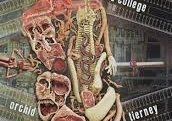
this abbattoir is a college
Orchid Tierney
Calamari Archive, Mar 2025
Temple Grandin designed the serpentine ramp to spare cattle the sight of their own slaughter. The curve absorbs panic. The animal proceeds. At the end of the corral, blue doors open onto what Grandin once called heaven, the killing floor she had stood on the night before completion, looking toward, asking herself whether her life had meaning. Orchid Tierney's this abattoir is a college takes Grandin's question literally, places it inside the curriculum, and walks the reader along the ramp.
The conceit is announced in the title, and the architecture is real. The D.M. Martin slaughterhouse in West Philadelphia, an early twentieth-century all-in-one factory abattoir, now houses, among other tenants, a Kaplan test-prep center. Tierney does not invent this. She photographs it. From that found correspondence the book grows outward through four sections—"design," "disappointment," "desire," and "cartload"—the last of which is the bibliography, the cart pulling away from the killing floor freighted with what made the book possible. The gesture is exact: works cited as offal, as evidence, as the price of admission.
What Tierney does with the conceit is what distinguishes the book from its many possible parodies. She does not merely assert that the university is a slaughterhouse; she builds the homology line by line until the reader recognizes the architecture from the inside. Limpet, the knocker on the killing floor, becomes a professor. Hog, the butcher, becomes a dean. "The unit"—a recurring figure designated by the book's own administrative pronoun—attempts and reattempts the novel, counting drafts the way academics count publications. This is the unit's eighth attempt to write this novel. This is the unit's eighteenth. The serial numbering is the book's joke at its own expense and its diagnosis. To be a unit is to be counted.
The sentences move by definitional fiat. A line is a city with a meatpacking district. A stanza is a standing place. A sentence is a unit in artificial tension. The formula is the book's basic enclosure, and tierney works it until it breaks. A sentence is a unit in artificial tension... a seraph is upstage of the artificial terminus. a serf is an uprising in artificial territory. The mantra of the disciplined sentence loosens into glossolalia. Discipline, the book argues, requires repetition; repetition, eventually, undoes itself.
This is not novelty for its own sake. Tierney is working in a specific lineage — Joyelle McSweeney's necropastoral, Renee Gladman's sentence-as-room, Cecilia Vicuña's precario, Sara Ahmed's What's the Use?—and she names her debts openly, often inside the line. "These sentences will form a sanctuary for refusal writes Gladman." The citation is not displacement of authority but acknowledgment of company. The book understands itself as collective labor, a position consonant with its politics; the acknowledgments are titled "workers whose voices echo through mine."
Some passages reach a strange concentration that the experimental hybrid form rarely achieves. In one, Limpet teaches "a successful poem," tying and untying his shoelaces between each line he writes on the whiteboard. The repetition does what a thesis statement could not: it shows pedagogy as ritual, as nervous tic, as the body's protest against its own assignment. When Limpet finally yells this abattoir is a college and burns down the classroom, the eruption is earned because tierney has spent the preceding pages binding the laces of her sentence to the floorboard. The catharsis is small and exact. The classroom keeps burning down. The students untie their laces.
The book's most extraordinary craft passage may be its most wordless. Pages 56 through 60, titled "a unit is perishable in the slaughterhome," proceed as a five-page argument that prose could not make. Page 56 is an orderly task list—the unit must finish the novel... the unit must stun the unit—left-aligned, accumulating into the kind of administrative document any faculty member knows intimately. Page 57 reprints the same text compressed and overlapping, lines crashing into each other, the column rendered as a corral wall or a body under load. Page 58 uncoils into a single serpentine S-curve descending the page—Grandin's calming ramp rendered typographically, the tasks now plotted along the curve that absorbs panic. Page 59 multiplies the curves into a braid of interwoven chutes. Page 60 is white space with a single word centered: no. These five pages may prompt some readers to close the book and walk away from it. The ones who stay will find the difficulty was the point. The sequence is concrete poetry put to ethical work. It shows the design from above—labor list as administrative document, then as physical pressure, then as Grandin's curve, then as labyrinth, then as the white space that opens when the unit finally stops. A reader trained to spot pattern will recognize the move before the prose explains it. Tierney does not explain it.
The book is not without risks. The repeated refrain monkey calves. paper sheep. accrues real weight at first and then begins, by the third section, to feel like a tic the book is keeping for company. The countersyllabus and the "lesson plan" near the end move from poem-as-thinking to manifesto-as-statement, and Tierney is a sharper writer in the former mode than in the latter. The instruction are you useless. are you useless. are you useless wants to break the reader open, and may, but the wager assumes a reader already inclined to be broken. There is a risk—the risk of any institutional critique published by a small press for an audience overwhelmingly composed of the critiqued—of preaching to the choir while the choir holds the only available pulpit jealously.
What rescues the book from that fate is Tierney's willingness to indict the speaker. The unit is not innocent. The professor Limpet, by the final chapter, is herded onto a lorry with the cattle and descends the ramp at his own "special graduation," "an angel for this royal occasion," waving to parents and colleagues while Hog hands out diplomas and the pneumatic gun beats through the ceremony. He is consumed by the very design he tried to revise. "Necropastoral" is the title of both the opening and the closing sections, and the closing one differs from the opening by a single word: indifference becomes persistence. The college, like the slaughterhouse, persists. So does the writing of the unit, which is to say, of the author, who teaches at Kenyon College and edits the Kenyon Review, and who has not pretended to write this book from outside the corral.
The book's final movement is its bibliography. Tierney titles it "cartload"—a word that does more work than it announces. Earlier in the book she has written that the academic job is a cartload of manure; by the time the reader reaches the works cited, the word has become structural. The cart is what hauls away the parts of the slaughtered animal. The cart is also the academic apparatus of citation, works cited as freight, the proof of intellectual labor that makes a manuscript reviewable, gradable, hireable. By naming the bibliography "cartload," Tierney refuses the gesture that closes most academic books — the works cited as monument to influence, the parade of names conferring authority. Here the names are freight. The book ends on the page where the cart pulls away. Whatever was the animal is now elsewhere, dispersed into citation, and the workers whose voices echo through hers—Ahmed, Vicuña, Gladman, Magi, Kaufman, McSweeney—are the ones still on the killing floor.
this abattoir is a college asks whether your life has meaning, and the question, repeated, becomes the book's instrument of slaughter. It is also the only thing the book is willing to offer in place of an answer. That refusal is its honesty.
J.M.C. Kane is the author of the non-fiction book Quiet Brilliance: What Employers Miss About Neurodivergent Talent and How to See It (CollectiveInk UK). He is an ASD-1 and writes from this learned experience. His prose work has been published in more than three dozen literary journals & magazines, including Plough, Camas, AMERICA Magazine, Commonweal, Smokelong Quarterly, and The New Ohio Review, where he won the 2025 Ellis Prize for Non-Fiction. He lives in New Orleans with his family where he works as an environmental attorney.