

If you write poetry, or anything of a literary bent, you must make your peace with a certain harsh reality. The sad truth is that most creative endeavors remain relatively, if not completely, unknown even in their own time, let alone in the endlessly opaque future. We writers create first of all for ourselves, hoping to make something we find worthy, and hoping most of all that it connects with the readers of our time. We count ourselves truly fortunate if it does.
But if we are at all serious we also create for those out of our time, those denizens of a mysterious tomorrow that we will not live to see. Our hope, however faint and ridiculous, is that what we have made will still have something to say to them, these blurry shadows of a future dark to us. It’s a poignant paradox. Only by focusing our full attention on what is happening within us and without us at the present moment can we make something worth reading. Yet only by having a mind for the eternal can we hope that our words may outlive us. Best then to focus on the work of the moment and let the future take care of itself.
There were a number of fine poets in nineteenth century America. Never a huge number, but still, more than a handful. For the most part, time has not been kind to them. Time is seldom kind to any of us. Some of the best poets of that period have had their verse overlooked or forgotten because it was not their main focus or the main thing of interest to their readers. Ralph Waldo Emerson and Henry David Thoreau come to mind. We certainly remember them, though when we do we are not generally remembering their poetry, which is actually quite good.
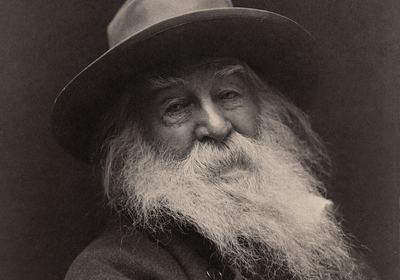
The two American poets of that time whom we all remember today are Emily Dickinson and Walt Whitman. They could not be more unalike. Dickinson the perpetual spinster wrote almost 1800 poems in rhymed, metrical verse. The vast majority were unpublished, unknown and unappreciated in her lifetime. She was born in 1830 and died in 1886 at age 55. Whitman was born in 1819 and died in 1892 at age 72. Rather than writing multiple books of verse he wrote just one, Leaves of Grass, which he kept issuing in fresh editions as he added to it. In a similar fashion some years later, once Ezra Pound had embarked on his life’s work, The Cantos, he would issue new sections by themselves as well as incorporating them into his ever-expanding magnum opus.
Fame came to Whitman with the first edition of Leaves of Grass in 1855. His fame grew with each successive edition and he remained one of the country’s most highly regarded men of letters throughout his life. The poem we’re looking at, “A Noiseless Patient Spider,” was first included in the 1868 edition. It consists of two five-line stanzas and one extended metaphor in which the poet compares the action of the human soul to the action of a spider spinning a web. A simple premise, concisely executed. More than a century and a half later the poem, and the spider, are both very much alive. Why?
The title is also the first line. The two adjectives, “noiseless patient,” work quickly to begin to personalize and even humanize the creature. They imply motive, purpose and determination. We normally associate these altogether human qualities with consciousness like our own. And we are not quick to attribute such consciousness to creatures outside of our daily orbit, though we do attribute it to our pets (for the moment I’m going to ignore those strange people who have spiders for pets, God help them).
So the poet begins by inserting his imagination into the mind of the other, this arachnid, making it a type of everyman. And suddenly we are pulled out of ourselves and made to identify with this humble being, engaged in a very human sort of activity, exploration of the inner and outer universe:
I mark’d where on a little promontory it stood isolated,
Mark’d how to explore the vacant vast surrounding,
It launch’d forth filament, filament, filament, out of itself,
Ever unreeling them, ever tirelessly speeding them.
The poetic means used here in stanza one are spare. No rhymes, no metrics because it’s free verse. However, Whitman does make excellent use of reiteration, repeating the words “mark’d,” “filament” and “ever.” He also uses alliteration, created both by those repeated words, the word “forth” and the phrase “vacant vast.” There’s truly quite a lot of music happening in this small poem.
The second and final stanza wraps things up nicely. It is bracketed by the evocative and passionate phrase “O my soul.” These three words are in the first line of the stanza, and they are also the last words of the poem, a repetition that resonates. So does the second line: “Surrounded, detached, in measureless oceans of space.” Isn’t that the state of existence for each and every one of us, human and spider alike? The third line is almost all verbs, five of them, and it’s the longest. The key phrase is “seeking the spheres to connect them.” And here, it may be, we have something that is for humans only. I don’t believe spiders seek the metaphysical spheres as we do. Prove me wrong, creepy crawlers!
The last two lines of the second stanza bring it all together:
Till the bridge you will need be form’d, till the ductile anchor hold,
Till the gossamer thread you fling catch somewhere, O my soul.
The thing that the spider (or the soul) keeps casting is both a “ductile anchor” and a “gossamer thread,” something simultaneously hard and soft. I think the toughness is in the absolute urgency of the spiritual task and the primacy of the spiritual side of our being. In essence, this is what we really are, however we may conceive that. The softness is in the nebulousness and uncertainty of our goal. “Somewhere” is not exactly a place on a map. As they sing in The Wizard of Oz, it’s over the rainbow.
“Promontory” is another word for “overlook,” and that is precisely what this poem gives us, an overlook of the human condition, with the spider as a stand-in for humankind. We too are isolated at the moment of birth and the moment of death. If we are conscious at all, we too spend our lives exploring our little worlds, which are the whole universe to us. In place of silken filaments we have our minds and feelings. Over thousands of years we have developed extensions of ourselves, technologies that expand the reach of our bodies and our senses far beyond what a spider can create for itself to increase its reach. And yet the spider metaphor remains an apt one. Because after twelve thousand years of civilization we can say that our search is not over. On some level, perhaps, it has not really begun.
As I read and reread this little poem I’m thinking of the Stanley Kubrick film 2001: A Space Odyssey. Like any great work of art, it never ages. Even when I first saw it at age fourteen, high on a dose of self-manufactured mescaline that I soon realized was unnecessary, superfluous, I could recognize I was in the presence of unprecedented imagination and daring. It’s the same feeling this little poem gives me, and I daresay the same feeling the poet had in looking on the spider and realizing his kinship with it. That is the mark of a great poet and a great soul.
As for my tribute poem, I freely admit it lacks Whitman’s empathy and admiration. My poem was written out of hate, and hate, as we know, is but the child of fear. I grew up in a household where spiders were better protected than the human children, which is a tale for another time. We write what we know. In my defense I can say that I’ve written several other spider poems that are more sympathetic. But as you can no doubt discern from the title, “Murder in My Heart for Spiders” is not one of them.
Not long before he wrote “A Noiseless Patient Spider,” Whitman composed “O Captain! My Captain!” as an elegy for Abraham Lincoln, recently assassinated. Whitman’s poetic range, and his range of interests, is practically boundless. If the ancient Greeks offer any clue, it is entirely possible that Whitman’s verse will live as long as our nation itself, the nation he so enthusiastically celebrated. This little poem might even outlive the US of A.

After years of writing humor for the New Yorker, the Onion and McSweeney’s Internet Tendency, among others, Kurt Luchs returned to his first love, poetry, like a wounded animal crawling into its burrow to die. In 2017 Sagging Meniscus Press published his humor collection, It’s Funny Until Someone Loses an Eye (Then It’s Really Funny), which has since become an international non-bestseller. In 2019 his poetry chapbook One of These Things Is Not Like the Other was published by Finishing Line Press, and he won the Atlanta Review International Poetry Contest, proving that dreams can still come true and clerical errors can still happen. His first full-length poetry collection, Falling in the Direction of Up, is out from Sagging Meniscus as of May 2021.