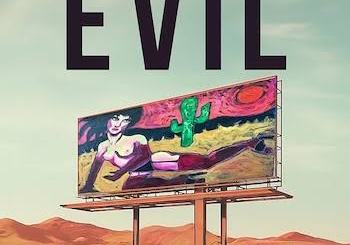
Old Man Evil & Other Stories
Vincent Czyz
Running Wild, Sep 2025
Arif, in “Arif’s Refusal to Bargain,” is an old man not much more than three feet tall who walks with a stick and never haggles. Asked to teach the young foreigner who tells the story how to bargain, he frowns: “How can I teach you what I myself do not do?” In the market at Mardin he picks up a carved black vase and, without asking the price, offers the dealer 250 lira. The dealer wants 320, then 300. “My friend, I have made my offer.” “I cannot go lower than 275.” “As you wish.” Leaning on his stick, Arif walks off. When the young man catches up and offers to pay the twenty-five lira difference, Arif clicks his tongue: “I make one offer, Yusuf. If the seller accepts my price, then it is Allah’s will that I have this thing. If he does not . . .” He shrugs. “It is also Allah’s will.”
Most of these twelve stories ran in magazines before they were collected, and three were nominated for a Pushcart Prize. The book has a great many moments as good as Arif walking away from the vase. In nearly every story, though, he builds something that works without a word of explanation, then doesn’t trust it, and stops to tell us what it meant.
In “Pub Blues,” Gladys, who is married, has sat at the same lobby desk of the Passaic Evening News for more than twenty years. A colleague, Vasilis, takes her to Pub Blues in Newark, gets her dancing, and on the drive back reaches for her hand. She doesn’t say anything when he turns off Main Avenue. They climb to his third-floor apartment, he kisses her, and then: “He eased her jacket over her shoulders.” After one more sentence, the narration spells out what the moment meant: “She renounced everything that could have prevented him from touching her—her marriage vows, the disapproval of her children, the judgment of God.”
“Tolstoy’s Kunak” does it twice. The young Lev Tolstoy is with the Russian army in the Caucasus, where a Chechen named Sado has made him his kunak: “friends for life or, if it came to it, death.” On the night before a battle he walks up to a white horse in the dark: “Lev pushed his nose into the musty smell of the hide, pressed his cheek against a muscular flank.” Nothing else is needed. The next sentence tells us what he made of it anyway: “Listening to the rhythmic thump, he decided that the heartbeat of the horse in its dark place was even more miraculous than the far-off sparkle of the star.” Then Lev asks the horse, “Could it be that God wants this slaughter?” and more questions follow. It is a good question, true to the story and to the young man asking it. The caption arrives on time, as usual: “Questions such as these troubled Lev Nikolaiyevich Tolstoy on the eve of his engagement with the enemy.”
Tolstoy could not leave a battle alone either—War and Peace keeps stopping to lecture its reader on what history is—and a story about him might have picked up the habit along with the name, which would at least be good company. But the same move turns up in a third-floor apartment in Passaic, which has nothing to do with Tolstoy.
I don’t want to make it sound worse than it is. Czyz’s glosses are seldom clumsy; most simply say again, more abstractly, what a moment had already said. What they sit next to is the reason to read the book.
“Contrary Star,” the last story, which first ran in this magazine, is where he leaves at least one image alone. S. David, an ex-Navy boatswain who has sold everything from encyclopedias “door to door” to rubber spiders, likes to call himself “a long-distance drinker.” For the narrator, who is his oldest friend, he is “a recurring event in my life without the observable regularity of an eclipse or a comet,” and tonight the event is a bar in Kearny, New Jersey. S. David brags about knots: “Got out of the brig once doin’ fancywork for an admiral. Two thousand feet of it. I could make about any knot that ever was, but I couldn’t take ’em out for shit.” Later the narrator remembers summers on a lake dock, and two wake-up calls. In the first, S. David went swimming drunk “with his clothes on (boots, too)” and almost drowned. In the second, the narrator found him on the floor of his room, “naked, a cigarette burned down to his fingers, his head tilted to the side—still trying to swim with his boots on.” Did the boots matter, that the narrator goes back to them the second time? What did they mean?

V. S. Maxon writes captivity and reads for it — the point where a form closes on whoever is inside. Within the Walls (2026) is a first novel; V. S. Maxon is a pen name.