The physicality of events. Where else have we sought the ultimate explanation for most transformations? And yet our interiority resists the physical with a damning effectiveness. It is simply a matter of turning to the efforts of education, to the campaigns of politicians and the pomp of ceremonies. We are there, but not there. We are husks for the time being. Our interiority resists, that is, until the rarefied spiritual pulse of the word seizes its rhythms. For this to happen, any book will do—or perhaps any verbal artifact. The spirit acquires perspective, and in an act of detachment realizes it has been adrift. Revelation. A revelation. It depends. What, in any case, could have been expected from the Physiologus in the twentieth century? The rush of excitement of a forgotten scholar who has stumbled upon a new theory of its provenance. The breathlessness of an avant-garde author who is struck by the totalizing hybridity of its form. The triumphant smile of a preacher who, at the last minute, understands that his rhetorical estate has grown lavishly. All of this. But not the inspiration of a religious founder. Yes, the word retains its sublimity even under the covering of a lapsed worldview. Revelation. To Eulalio, only one: the overabundance of meaning within Nature.
He was born in Velardeña, Durango. The population burned with unrest: the massacre led by colonel Jesús Garza González and all subsequent efforts at retaliation had consigned revered ideas of progress to a fictional timeline, where angels and saints once tread the ground. It was, however, a flame without ocote. Each revolutionary effort had asked everything from time and had succumbed to a critical mass of events. Calixto Contreras and Orestes Pereyra, dead in combat, were already heroes of epic stature—and Villa, the greatest of them all, had retired to Canutillo as a relic equal to the arm bone of the martyr Saint Sebastian (duly preserved in the Franciscan church of Xochimilco). Eulalio entered a world that still held on to sanctification through violence, and though this belief seemed close to evaporate into an abstraction, anticlericalism and land reform gave it a new body and breath. It is not difficult, then, to see why most speculation about his paternity revolves around bandits like “El Chojo” Ladislao or generals like Domingo Arrieta León. (I say most because there have been more “high-minded” attempts in this area of Eulology: a Soviet historian and linguist boldly proclaimed in an obscure opuscule that Eulalio was the product of a melancholy liaison between the engineer Álvarez y Zubiría and an exiled Russian baroness.) The interest of these speculations is, however, limited, for Eulalio’s true guide was Father Próspero.
Contrary to his fellow clergymen, Father Próspero did not live in a pious atmosphere of incuriosity. He was, as far as can be determined through the volumes of his sermons, a gnostic. Basilides, Cerinthus, Bardaisan, Saturninus, Priscillian, and Valentinus are referred to with gusto, whereas the Church Fathers seem to appear as an afterthought. His library, though not spacious, made the most of his ascetic habitation. Aside from the sermons, he wrote a treatise on education: On the Concentric Circles of the Soul and the Unequal Discipline. And here we find, in all probability, his approach to the tutelage of Eulalio and other orphans:
“Education” is a wearisome word that no longer serves its purpose. Which of our great ancestors would recognize its original majesty? To educate means to slash life in two: the time of soul and the time of body. The educator, moreover, is a bungler when it comes to the administration of this sacred time. Does he not imply with the asperity of his voice, the weakness of his posture, the sluggishness of his manners, that there is no significance to his calling? He merely replicates the dispositions that pervade the time of the body. If we wish to restore the unity of life, we must understand that the only legitimate time is that of soul and leave behind us all concessions.
The time of soul, then, required what he called the unequal discipline: an ordering of the day that mirrored the geometrically disposed inclinations of men. Sunrise, the outermost circle, warranted assistance to the community through physical exertion. Sunset, the innermost circle, warranted prayer, “an effort in blessed remembrance.” Father Próspero’s variety of Gnosticism did not condemn nature; it purely judged it a lesser gift, a humble incentive to explore the soul’s higher being.
Alert to the rhythms of day and night, Eulalio grew to love both. His discovery of the Physiologus in Father Próspero’s library bridged the gap between intuition and understanding. He loved day and night because they enacted the yearnings that beset him. The soul was not, after all, vaster than nature: it was intimately coextensive. This much we can say about his early youth without entering the arduous disputes of Ceniceros and Castaños, who believe, respectively, that Eulalio’s doctrine flows from Father Próspero’s teachings and that it is in violent discontinuity with them.
In fact, we are now fully dependent on Eulalio’s disciples. His first hierophany, which took place when he was fourteen, is narrated in Sixto Castaños’s Pronghorn, the most comprehensive life of Eulalio and (to many) a canonical book:
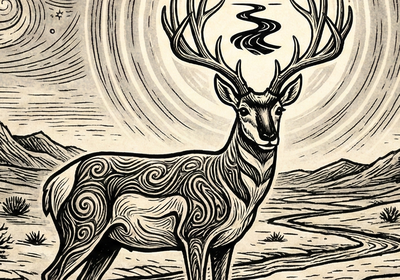
He was exhausted, and his peers were exhausted, and the whole atmosphere of the innermost circle signaled exhaustion too. They all were eager to lay the tools that had uplifted their souls, and they all were eager to pray and remember. He was as eager to lay his tool and pray as the mockingbird is eager to mimic the passing sound. But in his eagerness he lost sight of his peers, and thus he lost sight of his way. There was the plain, the mesquites, and his loneliness. And he did not entertain his exhaustion: for he suspected that in the innermost circle he would have to find a corner to pray. Corners he did not find. There was only the plain and now the moon. And he was lonely. His heart entertained fear as it did not entertain exhaustion. And he was confused. Then he heard the murmur of a river. But the murmur brought despair: for what he heard he could not see. Then the murmur coursed through him. He was the river. He was no longer exhaustion, loneliness, fear or despair. And every beast drank of his waters, and he became them. What need was there to pray? Covered in a delicate fur, he caught sight of his peers and of his way. And he ceased to be alone.
Matías Ceniceros, too, refers to this experience of the sacred throughout his writings (most notably in his grand polemic against Castaños, The Great Doctrine and the Little Doctrine) yet is careful to strip it of what he perceives to be an excess of mysticism. The river existed (Cuencamé) and so did the furred beast (a deer); the identification was of a rational turn and therefore solid ground on which to build a theology. We will return to this cleavage of dogma, but for the moment it is important to insist that Eulalio ceased then and there to be a student.
Still, he was not his own teacher. How could he be without the etheric and earthly perfusion of love? The being that refuses love refuses development, withdraws into a cocoon which is not silken but unbending. In this Freud is correct. Let us avoid, however, a rather simple misunderstanding: unrequited love is as strong and as salutary as requited love; it is not a perversion. You are carried away from the sick diameter of the ego, you become porous to the world-stream, you learn to expand and contract according to a distant cadence, you reacquaint yourself with awe. It is sheer vulgarity, sheer corruption, to insist on proprietorship. This insistence brings upon itself the heavy penalty of obsession. Unrequited love is not obsession. Eulalio fell in love with Natividad. And Natividad was cut off from corresponding to his love. At all times, but especially in youth, the love of man and the love of woman obey different temporal orders. She suspects something predatory in the abrupt energy of courtship and struggles to tame it—to understand whether there is anything behind the energy: animal, man, vacuum . . . soul. Was there anything behind Eulalio’s? Had Castaños and Ceniceros lingered on this epoch, they would have answered soul, but they rush toward the second hierophany and Eulalio’s mature thought. The courtship of Natividad stands in the same mist that permeates the childhood of Jesus. Ledger Rosenthal, the controversial British anthropologist, in The Construction of Religion in the Americas, has a brief passage that carries a measure of light:
Most followers, however, know nothing of the schism and freely indulge in an untimely bricolage of legend. The love that Eulalio professed to Natividad is a rich source: at every site consecrated to their brief yet resonant story you can listen to numerous variations. I was moved by the departure of Natividad to Europe. Near the sickly green bridge, an old man, impervious to the scalding sun, recreated their farewell with a serene disposition that was interrupted only when an intensely personal counterpoint seemed to take possession of his narrative: he had known Eulalio’s muteness before Natividad when he accompanied his only daughter to the bus station as she left to the United States and he had also known Natividad’s tenderness when his only daughter thrust her scapular into one of his hands and clasped it with rare strength. The love of Eulalio is everyone’s love; the loss of Eulalio is everyone’s loss. The episodes of his life must be seen as outlines that goad famished imaginations into the realm of symbols, where they can finally support their lives.
We are at the threshold. Matías Ceniceros has the best description of Eulalio’s second hierophany:
Velardeña had called, but there remained in him a tempest of longings to share in the activities of his fellows. He had nothing of the anchorite. Father Próspero recommended him to the priests of the Temple of Saint Augustine in Durango. It was a difficult excursion through his world into our own. The cathedral, like a couple of protruding fangs, welcomed him in the flesh only to see him off in the spirit. He felt the city was a series of abstractions, exclusions, and mutilations of Nature. He intuited that its aim was to imprison all principles of expansion in order to suit humanity to a lower being. The priests, finally, giddy with their abundance of pulque and tepache, content to plot against revolutionary factions, voluptuous in the acceptance of disreputable offerings, rid him of any conciliatory thoughts. The city was a blindfold, and its history was the hurried nullification of all aspiring.
Although the passage lacks the martial rhythms of religious solemnity, it lays bare the religious impulse, which is always a fury for restructuring. One can notice during moments of upheaval that politics, despite its attempts at refinement, is indiscernible from this impulse. Let us stress the word fury: in our sad days of technocratic regimes, the scientist who reaches power undergoes a ceremonial conversion that discloses another world—free of blemish; there is in the revelation of purity a lifelong intoxication, perhaps the only durable romance.
Eulalio returned to Velardeña after a recordless absence. Ceniceros and Castaños speak of a season of wandering through the barren lands. We can speculate that, wherever he lived, he subjected himself to the rigors of his new worldview, for he convulsed the people’s slow spirituality almost at once. This could be achieved only through example. Castaños’s Pronghorn details with profuse anecdotes and parables the yearslong conquest of a following: it is one thing to startle someone back into life, but another to keep them in life. The undeniably robust suggestiveness of Catholicism led most would-be converts to find in Eulalio’s ideas a quaint derivation. But before we say anything else about their reception, a summary, however difficult, is necessary.
Everything we know about Eulalio’s teachings comes from his two greatest disciples: Sixto Castaños and Matías Ceniceros. In spite of the miraculous intervention of the written word in his life, Eulalio felt no vital attraction to it. Perhaps in his wanderings he thought of the immortality of Socrates, Jesus, and Buddha; perhaps he thought of the incriminating essence of all books. Both Castaños and Ceniceros believe otherwise: the volatilization of the I that Eulalio so deeply embodied ruled out the peace of mind that writing demands. Incidentally, the volatilization of the I is a fine point to build upon. Each of us is gifted with a private universe that is a delectable, if limited, version of Nature. We explore it almost by accident and come, in time, to identify with it: the resulting map is the ego. Further excursions can amplify the territory, but for the most part there are no great discoveries. All great discoveries, in fact, must be aided by Nature, and so detach us from ourselves. Then we can speak of an ascent in identification for the I: with the animal, with the plant, with matter. To be clear, the ego is pure interiority; the I is the effort to expand outward. Everything that has been stated is contained in the volatilization of the I, which is the great method that leads to the substantial experience of Nature. I am here using Ceniceros’s terminology. We can clarify it somewhat if we borrow from Rudolf Otto’s The Idea of the Holy: the ascent in identification is the mysterium tremendum, and the substantial experience of Nature the mysterium fascinans. To Eulalio, the numinous is cyclical, in no way persistent. We undergo long periods of its absence. Yet wherever it has been, wherever it has led us to identify with animal, plant, or matter, there we must re-create its arrival.
Prima facie, this is a religion with a strong individualistic bent. We all carry a private universe of our own that will share little with that of others. We all will struggle for salvation at different tempos. Indeed, volume after volume, Ceniceros has theorized as much. Against him, festivity after festivity, Castaños has championed a maximally communal religion. The private universe chains us to individualism, but in the effort to ascend we share in the bounty of Nature. Here is the great cleavage. Here we have opposing views that have brought singular forms of premature decadence. We will approach each of them in turn and analyze how Eulalio related to it.
Matías Ceniceros was not a native of Velardeña. He was born in Guadalupe, the son of two relatively prosperous teachers. After a somewhat irregular formation in the city’s itinerant seminary, he traveled throughout the country as preacher and journalist. His nomadic existence was the consequence of increasingly radical beliefs on the nature of religion: a moderate skepticism about Catholicism’s adequacy for the modern world grew into a full-blown rejection. More than once, his brilliance as a polemicist attracted comparisons to Jaime Balmes. But his labors lacked the constructive element. It was only in his mid-thirties, as he lay exhausted and mired in cosmopolitan eclecticisms, that he heard of Eulalio Salmantino. As the sixties reached a glut of supply in spiritual commodities, Ceniceros found a dogma. He arrived at Velardeña when a good part of the community was supporting Castaños in his dream of rivaling the Catholic church’s organization. In this, he and Ceniceros seemed destined to work harmoniously. But through their immediate gains they drifted apart: Ceniceros managed to capture the attention of the intelligentsia, and again succumbed to wayfaring. There were only two reasons to keep returning to Velardeña: the budding press and the “peregrinations.” Both initiatives had international reach as an objective. The press was dedicated mainly to the publication of Ceniceros’s own work (and later on to that of his cosmopolitan pals); the “peregrinations” were no more than tours led by Ceniceros for the diversion of curious foreigners (invitation only, of course). If Eulalio has figured little in Ceniceros’s trajectory, it is owing to the sage’s unrelenting coldness toward him, especially during the final years. This has encouraged some specious criticisms, none so common as that which imagines Ceniceros’s graphomania a compensation for the absent patriarch. Matías Ceniceros is a philosopher. It was never within his purview to understand the core of Eulalio’s teachings. We can affirm that he understands Eulalio as much as Kierkegaard understands Christ, which is to say, very little. This is not a critical remark. The philosopher is a creative misunderstander. He must err to find the enlivening pathways, or at least to amuse us out of complacency. And yet Ceniceros is not wholly a philosopher. He wishes to reach posterity in the disciplined ranks of a school. He has no patience for the diffuse influence of private and chance encounters. In this matter, he is a model advocate: the teachings of Eulalio will spread even if this means their burial in abstractions.
With Sixto Castaños we face the problem of loyalty. Born in Cuencamé, he soon ended up in Father Próspero’s orphanage. There are credible sources that tie his parents to the Sinarquista movement; those who speak of their unsuccessful revival of violence through independent guerrilla campaigns go a step too far—a dark background against which Castaños’s gregariousness can radiate the more. For this is his abiding inclination: under his firm support, Father Próspero’s educational project flourished for a brief period; likewise, Eulalio’s arduous example became an incitation to holiness. Castaños is the pupil who asks of his teacher a permanent guidance, who impels him never to permit a levelling. He senses that autonomy is divinely ordained, and that there is no joy therein for the earthbound. Thus, he disappeared into Eulalio. How did they meet? How did their relationship develop? With great consistency, Castaños offers no answers in Pronghorn. No explicit answers. In a rare passage of convoluted metaphysics, there is an intimation:
Then the dog perished. Every man and every woman accompanied him in his grief, for they knew that the loss of life, in spite of their hopes, is an affront. They withheld their gifts, for they knew that a gift without festivity is an affront. They commiserated. Then he reprimanded them for their lethargy. And he spoke of the dog as he had spoken of the sun that very morning. He said of the dog as he had said of the sun that the eye belittles it and that the eye ignores what the rest of the senses understand. He said of the dog as he had said of the sun that it is vast because in its service there are no limits. So the men and the women listened, but they could not rid themselves of their pity. And he spoke of the dog as he had before spoken of his own entrails. He said of the dog that its movement could cease yet not its linkage. He said of the dog that its span was an echo of a greater span and that there labored an echo more. So the men and women listened and cast off their pity. They set foot in his gladness. There was no grief.
For all Castaños’s devotion, Eulalio still seems to elude us. Is not the most fervent pupil equally the most intense traitor? By becoming a mirror, he predisposes the other to vanity. It would be a mistake for us to sever the religious impulse from vanity. That fury for restructuring borders the need to do so in one’s own image. The lures of asceticism and mysticism respond to this threat with the detonation of the self. But Eulalio, by allowing discipleship, allowed distortions. Let us again emphasize that this is not the loving distortion of chance encounters, which is ultimately a form of justice, but the distortion of unperturbed loyalty.
In his final years, as his disciples quarreled, Eulalio reached the autumn of notoriety. Most national newspapers began to show great interest in his community and in his views, while television networks wrangled for an interview. Yet as the essence of his work became clearer, the commotion subsided—the last thing the (always) rising nation of Mexico needed was a mysterious sage who insisted on the sacredness of nature and who sympathized with movements like the EZLN. And as it subsided, it turned to the resources of scorn. This is the way of the nation: everything but industrialization and trade is a matter of laughter. He died in a very different world, innocent of the struggle for an ideal, violence the lone surviving tradition. Those who surrounded him in Velardeña do not constitute a decisive number.
Yes, Eulalio is lost to us. There is no human being as irretrievable as the religious founder. The word, so dear to Eulalio, is a seed that in its growth becomes unrecognizable. But can there be a greater fate? To utter and then become the uttered, and as the uttered to live in the realm of meanings, inaccessible. Devotees do not remember Laozi, Zoroaster, and Moses. They instantiate through conduct all that is suggestive in their words and thus keep apace the luxuriance of the foliage. In their inaccessibility, they remain divine. More than all the others, the religious impulse is rare, for it grants the word its primal sway. The Physiologus transmitted something of this secret to Eulalio, and he made sure to cherish it.

Israel A. Bonilla lives in Guadalajara, Jalisco. His work has appeared in Able Muse, New World Writing, BULL, Hawk & Whippoorwill, Expanded Field, FEED, ONE ART, Letralia, and elsewhere. His debut micro-chapbook, Landscapes, is part of Ghost City Press's 2021 Summer Series.