


Soft Lighting
Jared Joseph
Bench Editions, Oct 2025
Reading Soft Lighting felt like navigating a maze of memory made of soft clay, forming and reforming bits of it, attempting to find a person. The novel’s core is a question: how is it that we might operate interpersonally, interspecifically, or interspatially, let alone correctly, when each of us is fated to view the world only from our own perspective? In Soft Lighting, Jared Joseph re-creates individual perceptual limitation through writing that limits itself to only the first-person stance. He sets out to write a novel with no setting, which means a novel with no main characters. The book is pure substance, a world created with a big question mark over “creator” (much like ours). How much of our existence is who we are, and how much is what we do? Must personhood be attached to action? Responsibility, relation, and accountability are investigated, positioning today’s violence and oppression in a bubble of why and who. Soft Lighting is an experiment, an asking. I found Joseph’s authorless world to lack no meaning. Sometimes it is not how we came to be here, but simply that we are here, in this room, where the lighting is soft, and there are some things we just can’t make out.
Soft Lighting has no sections, no table of contents; the novel avoids demarcation in its very form. The only separations are between paragraphs, or speakers, all of whom are “I”. Each paragraph functions as a synecdoche of the full work, with its own rules and its own ecosystem, repeating or revisiting concepts cyclically with a pattern like an internal palindrome. The novel speaks for itself, since it speaks only to itself. In one conversation between “I” and “I”, the speaker asks, “Does this statement in any way reflect the thoughts I was having beforehand?” (98). The question references a concern of inconsistency we might have when thoughts become constrained by the symbolic realm. It is a way of validating the insecurities of any writer or speaker; “I” in this sentence is the speaker of the novel and “I” is also me, and you, and anyone. Through the novel’s alien landscape formed by the lens of deeply personal anonymity, questions that move intensely past masks of convention or norm are welcome. Soft Lighting is more lawless than most works, and it becomes that by being strictly law-abiding.
Without names or places, Joseph must rely on other meaning-making devices in his novel. Geometric metaphors enhance his larger investigation of relationality and solitude. One “I” describes an oval as the primary life-shape, representing both the closeness of intimacy and the distance of betrayal, and functioning as primally as planetary orbit (123). Soft Lighting does follow the shape of an oval, because of the concurrence of intense vulnerability due to being locked in first-person mental space and jilted communication due to talking across or at each other, “I” to “I”, no actual translation possible. Elliptical swooping is between us in connection, in individual orbits of life, and in conversation; as another “I” says, “a conversation never really dies, but pauses, as the two inside the conversation separate in space, but there is a thread between us that is unbroken” (163). As well as the space between speakers, Joseph investigates the space between thought and speech, often following “I say” with a reflection on whether what was said was thought, or what was thought was said. The novel’s speakers ask, through this separation, through the one-mindedness, if we can ever really communicate and be understood. Although the space between self and other is emphasized, there is suggestive hope, too; Joseph introduces the possibility that we both think the same thing we don’t say. One speaker comments that “Sarah wants to ask the question ‘why did you stop loving me,’ but Sarah will never ask that question, because I will never answer it, and so it isn’t allowed” (165). The acceptance that “Sarah” and “I” share a law brings them both into a new sphere, crossing boundaries between each mind’s thoughts by acknowledging a rule that spans both, locking the dyad in an ontology of their own making.
Soft Lighting’s speakers probe the limits of responsibility in autonomy and relation. Joseph begins his solipsistic project in perhaps the most ambitious territory one can find for it, writing “I”’s who date, grow closer, and eventually engage in physical intimacy, each a lone protagonist in what can seem a necessarily multi-person experience. The discomfort of reading a conversation between me and myself is made vulgarly salient when that conversation becomes sex, and explicit physicality occurs between me and myself, bringing what is arguably the most vulnerable form of relation inward and the most vulnerable solitary act outward. Does physical intimacy require two or more people? Why is it that when reading it between one person, I still saw two people? Joseph writes, in his Notes section, that he found the process of writing a novel with no setting to be difficult and frustrating; what about the process of reading it? Why did I find myself needing to ascribe multiple selves and personalities to the “I” present, and did Joseph do the same in his creation process? Relation, here, is probed as a polyvalent process. The repetition of the pronoun “I” in the novel aesthetically evokes a Kantian autonomous rigidity. The direct and continuous exploration of that self in relativity with others, however, continually draws out an inclination, a bend toward the other. Through his form, Joseph touches on the paradox of the Kantian upright symbol; if inclination, as Kant understands it, is necessarily an outward turn away from the self, then in what direction does a self-love go? When I speak to, fall in love with, and have sex with myself, where have I inclined myself out of rigidity, or where have I collapsed?
Where self may be located draws itself out in the novel through an investigation of definition. Joseph asks what is necessary for existence by exploring what makes up a who-ness. “Does a name live while a body dies?” one speaker asks (36). Does it matter how we are remembered or can be referred to, or is the who-ness located in our corporeality? The question of accountability follows from this investigation of who we are: how responsible are we for the actions of our past selves, or our future selves? To whom are we morally obliged? Following the section that delves into intimacy and relationality romantically, a speaker laments “‘But we may not have much time together, soon, I don’t know when we’ll switch’, I say . . . ‘I’m going to miss us,’ I say” (39). I first understood this as a pre-grief of a romantic relationship, but I came to understand it as a grief of the last person the speaker was, and a fear for the next person the speaker will be. On the back cover of Soft Lighting, the concern is expressed that “once I’ve written an autobiography, that autobiographer is a dead person”. A new option arises, then, for what dictates existence: perhaps not a label, or a physical existence, but a temporal one. When the we we are now has passed, must it die? Can it, and how might it, continue to exist in our reference of it? Because each version of self has once been born, can it continue to be, even when temporally dissolved? I’m always going to miss me, but I’m always right here.
Joseph has a tendency to break the fourth wall in his writing by asking, near the end of a work, what has really been going on in the journey of writing or reading. In Soft Lighting, in one of several eponymous expressions, a speaker asks “‘What is this room?’ . . . ‘What are its rules? I know I can’t see anyone well, or myself, but there is still lighting in it, a soft lighting’” (140). Options are considered: maybe the setting is purgatory, maybe it is death, maybe it is life now, maybe it is life in a different time. The irony is that the book does have a setting, and its only setting is soft lighting, a cytoplasm of this questioning organism of a novel, confirming only that our limitations are valid and our confusion is true. The thing about light is it demarcates, and the thing about soft lighting is we can never tell what is being demarcated, not quite, even as we come close. The fog of the novel is dense, but its meaning is brilliant. Joseph closes his novel with a question asked by none of the “I”’s, with no quotation marks, plainly: “What’s the difference?” (177). It’s about separation, sameness, violence, and peace. Each “I” has told a different story, through a different gender, body, political orientation, backstory, and profession, but each “I” is making and asserting themselves through the softest lighting. Existence is something reached at by each self, and maybe but maybe never grasped. Why are we killing each other, Joseph asks? What is the difference?
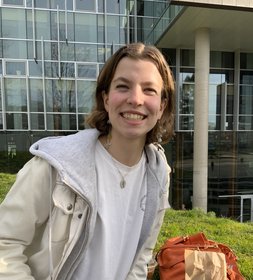
Isabelle Whittall is pursuing a Bachelor of Arts in Philosophy and Political Science at the University of British Columbia (UBC). She co-hosts the radio show Hail! Discordia! on CiTR 101.9fm, and is Editor-in-Chief of UBC’s Journal of Philosophical Enquiries. Her work has been published in Discorder Magazine and The Sundress Blog by Sundress Publications.