‘He was seventeen years my elder,’ she said, the woman on the hilltop, her face turned away from me, her words difficult to make out. She was conning the horizon, right hand flat above her eyes. ‘And he’s been dead ten years.’
She turned to face me. ‘We only had three years together. He was my first love. Not many years’ love in a life, is it?’ She put her lips together, protruding them thoughtfully, her expression one of sadness. ‘Well, why should I confide in a stranger? Why did you climb this hill?’
She was a small, slender woman, perhaps fifty-five. Behind her rose the squat, octagonal drystone tower with its narrow windows. ‘No matter. There’s a tale of a whole line of signals: at night, fire-beacons. Here, where we stand, is just one link, it is said. They call it The Line of Works. Do you know anything about it?’
‘Nothing,’ I said. ‘I didn’t know such a warning system existed.’
‘Is that what you think it was?’ She made a little grimace. ‘I know little about it,’ she said. ‘Only my link in the chain.’ She followed the line of my gaze across the landscape below. ‘I’ll show you round. It won’t take long.’ A thought seemed to glance along a tangent of her mind. ‘He was a philosopher, you know,’ she said, her dark eyes keenly watchful.
‘Which views did he espouse?’
‘His own, of course. Who else’s?’ She laughed. ‘The fish in the river down below are quite prolific. I use woven willow-baskets, as did he. Eels. I spear them. You crouch at the water’s edge, low in the denseness of the reeds. And there are pigeons which roost in holes in the stonework of the tower: I take their eggs and make stews of their unfledged squabs.’ She tilted her head and held her small, neat hands in front of her body. ‘And vegetables. Samphire provides salt. I found a parsnip and kept the seed, year after year. I don’t like parsnips much.’ She shook her long, iron-grey hair. I wondered if she were mad.
‘Excuse me while I take a sighting.’ She laid her hands to either side of her eyes and scanned the horizon. ‘Let me guide your eye, stranger,’ she said. Her forefinger was steady. ‘Do you not see? Yon hill; our predecessor in the line, oh, fifteen miles away?’
‘I see a bald summit, wooded at the flanks.’
‘That is she,’ she said. ‘Your eyes are sharp.’ She rolled her lower lip over her upper. ‘And the weather’s clear this morning. Her semaphore is uncommonly brilliant.’
‘What is its name?’
‘Her name. They have names of women.’
I smiled.
‘Don’t smile like that,’ she said. ‘It doesn’t mean much. Only unthought expressions come to mean, or so I believe. Now. My squint: my sighting.’ She put all her concentration into her gaze between the flats of her hands. ‘Nope. Nothing. She’s flat. All the same as this time yesterday. Now. You were asking her name?’
‘Yes. Does it have a name?’
‘Why is her name important to you? You can’t summon her. She isn’t going to move. And I am always here: if not for quite as long. She, she may speak to me. I have no need to speak to her until that time. I take a sighting every ten minutes, and at night every half hour.’
‘How do you sleep?’
‘Let me show you round. There’s ten minutes before the next sighting. I’ve trained myself to sleep for half-hour periods. The sightings are easier at night: I just have to sit up in bed and push aside the sacking from the semioscope—a little angled channel in the wall—and look out. I make a notch with a knife on a hazel tally-stick. It’s a lot for one person, and I am always busy.’
We walked towards the semaphore tower. The tethered goats strained towards her.
‘It would be easier with two. You can work shifts. But it’s a meithersome task for one, and there’s no reward.’ She paused, her face anxious. She laid a slight hand on my forearm. ‘No. No reward. The thought would trouble. Even the thought of the last valediction troubles: well done, thou good and faithful servant. Here.’
She opened the door of the tower, gave a tiny curtsey. ‘The place of my confine. Come in.’
We stood in the relative darkness.
‘Beaten earth floor, walls mud-plastered. Fireplace for cooking. No utensils; they’ve gone long ago, except for a cast-iron stew-pan. I found it in a ditch and scrubbed it with sand.’
‘How do you light the fire?’
‘In winter you keep the fire going day and night. It’s troublesome fetching and carrying wood and water.’ She considered something carefully, her head on one side. ‘He always asked the question, the philosopher, my man: are days passed on by sentiences? He believed it so, and I agree with him, but I’m a little more practical, I think, than he, and who hands on days is of little everyday concern to me, as long as they continue to arrive. And who hands on generations? I don’t know.’ She grimaced. ‘I calcine bones at the fire, grind them, and mix the ash with grease to whiten the semaphore arm. It must be kept visible.’
She folded her arms over her thin breast and smiled at me questioningly.
For some reason unable to meet her keen gaze—so questioning it seemed childlike—I looked round the room.
She watched me, taking my hand in hers. ‘Everything is made of stone and driftwood,’ she said. ‘Look down through the window and you’ll see the stone breastwork of the clyse. At the beginning of an incoming tide you’ll hear a hollow boom as the bore strikes the clyse’s seven valves and closes them to stop the ingress of salt-water. It’s an uncanny sound. On one side—mine—clear, fresh water, and myself crouching on the bank, looking down at my own reflection. On the other side—the sea’s—churning, turbid brine, wreckage, disjecta, spume.’
She smiled at her own description. ‘Spring tide at the moment. It’ll be a strong bore, with the wind against it, piling it up. Driftwood, cordage; it’s all useful. The floor and the roof are driftwood, too; the rafters are curved: they were once the ribs of a vessel, so he told me. I’ve never forgotten.’ She pointed round the room with a lean, bluish finger. ‘Fireplace: mantel: wild flowers in a jar. Harebells. A beautiful blue: the most beautiful of blues. The most delicate venation. Next to them a piece of volcanic pumice; all bubbles. You find it all the time, washed up. Table. His predecessor made it. She was a fine craftswoman; she made most of the furniture. She was fifteen years older than he. He believed in her and became her spouse: she was his first love. They were together six years before she died. She’s buried outside, next to him.’ She plucked at her upper lip with her right finger and thumb. ‘Chairs. Violin, found on the tide-line. From a shipwreck, possibly. All split, of course: it’ll never play. Come upstairs.’
The ladder was of crosspieces lashed with cordage to the side-timbers. She climbed with dexterity, grasping each crosspiece firmly. How worn they had become beneath her little feet.
I followed her upstairs to a low-ceilinged room with a little sighting-port—a semioscope—which faced the distant hill.
‘I’ll take a sighting,’ she said.
While she took the sighting I looked round the room. There was nothing apart from a bed of bracken—you could see the impression of her body—and, in the half-darkness, the huge wooden image of a young woman’s head, her frank blue eyes looking sternly ahead, coils of profuse, golden hair wrapped about her neck—the figurehead from the prow of a vessel.
‘Her signal’s flat. Let’s continue upward,’ she said.
Another climb and we were on the roof.
On the roof was a tall pile of driftwood, all carefully angled so that rain would run off. On a tall mast above the whole tower was the semaphore itself, a single horizontal board about twelve feet long, two feet wide, carefully whitened, which hung from a fulcrum in the mast.
‘When the signal comes I shall undo the cordage from the cleats and pull the horizontal semaphore so that it stands diagonal. That transmits the message onward. What happens then? The system goes into reverse. This isn’t difficult to understand, but, because it’s never happened, it’s important to practise in the mind.’
She paused at the top of the ladder. I almost think I’ll sense her raised before I take a sighting. “Flat,”—she made a horizontal motion with her bony hand—‘and “raised”’—she made a diagonal sweep. ‘Those are the correct terms of the semaphore. Not the terms “off” and “on”.’
We carefully made our way to the ground floor.
‘What do you do for light?’
‘I go to bed when daylight goes. And I rise when it appears.’ She looked at me, her gaze affectionate. Her face was lined from exposure to the elements. She would often open her mouth to its fullest extent, not in a yawn exactly, but in some manneristic way peculiar to her. I liked her: her grimaces were endearing; exaggerations of her underlying emotions, though in hindsight I guess her emotions were exaggerated also.
‘Now. Tell me about yourself.’ She folded her arms and rested her elbows on the table. ‘How you came to find this place.’
‘I’m not sure it’ll stand being put into words.’
‘Try.’ She laid her hands firmly in her lap, fingers dexterously intertwined.
And so I recounted my travels—though the ordering of the fugue-like sequence of days was beyond me—while she sat at the table.
‘I saw this hill from a distance: when I was closer I could see the beacon-tower: in another few miles I could see the semaphore itself. Dawn was breaking as I climbed up through the woods, and looked up. And there you were, your skirts blowing in the wind, your arm raised.’
‘My arm was raised. I saw your approach.’ She pressed her lips together so that her mouth was a thin streak; above it a thin nose. ‘Now it is time for me to play the schoolmistress.’ She rubbed her hands together. ‘Dinner wasn’t much, but sufficient, I feel. Now. How the signal system works. I can extrapolate from this one station, and I’ll tell about that, as much as I know. Well, first of all, I’ll tell you this: the chain of signal towers has a finite length. How do I know this? I have worked it out myself, during sleepless nights.’
She laid five small sticks, each about four inches long, on the table-top. She held up a slender finger. ‘The Line of Works is of a length unknown to me. Picture a small section of the Line. Observe these sticks. There they are. Five signal stations. The semaphores are flat. All are horizontal.’ She laid them so. ‘Five stations on five hills. We shall call these five stations α, β, γ, δ, ε. We are station γ. Fifty or sixty miles are accounted for in this little catenary. Now, in the forward transmission of the signal—whatever it may mean—the divine grace moves above our head. At present all the semaphores are flat. So: I lay the first semaphore, α, to signal: she’s now diagonal. She forwards the message to β. β lays her semaphore to signal. Simplicity itself. Next: two events happen.
Firstly, β transmits her signal onward to γ. When she sees γ’s semaphore go diagonal, she replaces her own semaphore to flat. This shows a that β has made her onward transmission. When γ passes on her signal to δ and sees that she has done so, she returns her semaphore to flat: β observes this and places her signal to diagonal. a sees the movement of β’s semaphore and reverses her own. And this line of verification shows, step by step, the originator of the message that the chain is functional. Each and every station is accounted for. The transmission of the signal of itself demonstrates the integrity of the Line of Works.’
Her eyes were kindly in her little grimacing face, her gaze darting everywhere and then lighting on me with great affection. ‘Two pieces of information have been effectively demonstrated: The message has been passed and the system itself is verified. And all one’s life is dedicated to that; indirectly, perhaps; polishing, whitening, mending, cleaning, feeding oneself.’ She held up a finger. ‘Class suspended. I must take a sighting.’
She stood, looking out of the window, her hands aside her face. ‘She’s flat.’ She laughed, inwardly. ‘Oh, I like my friend,’ she said, returning to the table, clasping both my hands with hers, and drawing this ball of extremities into her little lap. ‘So. That’s it, really. How many people there are who dedicate their lives to the maintenance of this Line of Works I do not know. Nor even—’ her voice dropped. ‘Nor even if this is a secondary line of signals. Perhaps. Once, five years ago, I saw a line of beacons, in a spectral haze, far away—Well, so we spend our lives. Are they valueless? Why ask me? Who notices me? La folle au bord de la mer?’
She released my hands. The marks of her nails were imprinted on my palms. ‘We know so little.’ The room was silent except for the click of embers in the hearth. ‘Maybe there’s little to know,’ she said, breaking the silence. ‘Maybe. Maybe the complication is made by looking from your own viewpoint, where everything goes a double turn, like planets in the night sky. Epicyclic gears. Complex, a slow click as one takes the night-road home.’ She sat stock-still, listening. Then she relaxed, though nothing had been audible. ‘Maybe it’s all quite simple, and we blind ourselves with words and beliefs,’ she said, decidedly. ‘You’ll want to know where you can sleep. On the bracken with me, but as friends. When I was a child we were four to a bed. How innocent! And how much an allegory!’
So, after washing at the spring we climbed the ladder and lay in the bracken.
‘That’s that,’ she said. ‘A useful day. A day somehow complete. Another day burned to a cinder. In many ways it’s like the signal chain itself. A catenary of days.’ Her voice was alert in the darkness. ‘Now. I’ll wake up at half-hourly intervals to take a sighting. So. For tonight you can have a full night’s restful sleep as you are in a strange bed, but tomorrow I’ll wake you at two hourly intervals.’
The light wind sang in the drystone walling of the beacon tower, and the moonbeams fell through the sight-hole onto the keeper’s sleeping face.
She rose at first-light and shook me. ‘Nothing all night: no fire, no flame,’ she said, combing her iron-grey hair with her fingers. ‘Revertere, revertere, Sulamitis; revertere, revertere ut intueamur te. Return to me, my beloved Shulamita—’ she whispered in an undertone, her face to the wall, her hands spread out on the stones.
We stood on the grass outside the tower. The wind had risen and was noisy in the drystone walling. This noise would come to haunt me; it had overtones of the keeper’s voice.
‘Did you sleep well?’ she asked. ‘I suspect so. I looked down at you after I had taken my sightings, every half hour; your face was calm, your limbs like a child’s.’ She plucked at my sleeve. ‘My pupil. Let the class begin. Look—You see the hill, a comely shape. You see the semaphore above her, flat. There.’
She pointed with her slender arm, as though she would at that distance pin it down with telescopic physicality. ‘You see it?’
I looked at the bald summit of that distant hill. ‘I think I see it.’
‘That’s not good enough. You must see it.’
So she kept me there, overcome with hunger, in meditation on the distant hillside.
‘Do you see it?’ she asked.
‘I see the summit of the hill, and an outcrop of rock—or maybe a tower—’
‘He had to starve me into seeing it,’ she said. ‘It was three days before it became plain to me. It is like learning to wake at night. It is a kind of discipline. But water you must have. When I saw it clearly he made a little feast for me—oh, what he had to hand, and I slept a day.’ She put her head on one side. ‘Strive; strive, my student: strive with dignity and with love.’
And so I looked at that hill for three days, my teacher standing behind me. I knew all about every single conformation of its sides,—as viewed from my perspective—and as I looked out the fourth morning the further semaphore’s whited board was clear to me. As clear as anything I have ever seen. It was flat.
‘Now. Something to eat,’ she said. ‘ Your eyes will be full of signals from now on.’
Over breakfast (she had lit a fire in the hearth, the morning being cold) she suddenly said: ‘Soon enough your sentence ends: you are not locked up for long. Look for yourself again. A chain of towers, spatial: a chain of keepers, temporal.’
We left the tower and stood outside. I saw the horizontal semaphore against the purple of the further hills.
‘The goats need milking. I’ll show you how,’ she said.
While she milked the goats she smiled. ‘Kind little creatures,’ she said. ‘They hear the sound of the wind in the stones of tower and it soothes them.’
And so I was her industrious pupil. We began to form our own way of speaking, over the years. She once told me that she wished for no better company.
‘You think I am capricious, living with goats, but I am not. I give them my attention, and they give me their companionship, and their milk. Milk on a windy hilltop: what could be better?’ Her eyebrows formed a single solid line above her eyes. ‘I am no philosopher like him,’ she said suddenly. She looked at the distant hill. ‘She is changing colour: the mists hang on the hems of her skirts and the air is still. How her moods and emotions pass from one to the next.’ She looked at me, her eyes full of affection. ‘So, you stayed with me: you gave your life to sustain the duties of generations. Each morning differs. Many years ago I told you he was a philosopher. You not unreasonably asked: which philosopher’s teaching did he espouse? I answered: his own. Who can lead your life but you yourself?’
I nodded my head. I had become somewhat mute over the years. I let her do my speaking for me.
‘He was one for soliloquies after I arrived. I said little, save to occasionally prompt him.’ She raised her narrow shoulders, and then dropped them, the left one first: then she alternately raised and lowered each shoulder. Finally she stood with arms and legs akimbo. Her eyes were like pools of peaty water. ‘And when I go, then perhaps you’ll have time on your own to recover your voice: and another will come, and you’ll be vocal. So. Go check the snares. If successful, skin, disembowel and hang the bodies in the shed.
I’ll go check the fish-nets.’
She laughed, ‘And they are doing just the same elsewhere: keeping their bodies active in readiness: and it all depends on the slaughter of small creatures who have no understanding of why they came about. This is the Line of Works: what sacrifices are made to it.’
We walked together, then parted: she to the clyse and I to the wooded glade on the shoulder of the hill.
We met an hour later.
‘How many?’
I held up three fingers and pointed to the shed. She liked a certain gaminess, saying it stood in for seasoning, which we did not have, apart from wild garlic.
‘Well, my fine forager,’ she said, smiling. ‘It’s colder. And I have doubts.’
I stood before her, my expression interrogative.
‘Yes, I have doubts. As I was looking out this morning, at the semaphore on the summit of yonder hill, pelerine-like clouds above her, I wondered about the intactness of the Line of Works. Are there missing stations—empty links?’ Her eyes opened wide. ‘It suddenly came to me that almost certainly no message would ever be sent. No message has ever been sent. That’s a certainty: it’s one fact a keeper always passes to his or her successor. No signals in the past, not one: the future we cannot see, unless it’s something like an hour-glass, which, when its run is completed, is reversed. In which case there will be no messages transmitted in all time to come. And that is what the Line of Works will be: something akin to parable, a tale told. That it is—or may be—a parable is seen only towards the end of a keeper’s sojourn. And he or she keeps the thought to him or herself. Do you see? The system of transmission, theoretically intact, visible in the line of unlit beacons and frozen semaphores, can bear no real use. It is pristine only because it cannot be touched.’
‘I can read your expression,’ she said one time. ‘You don’t need words. You can be as dumb as a beast until I’m gone, then you’ll find your words with ease.’ She put a finger to her lips. ‘See? Nothing of significance can be transmitted.’
She playfully fondled a goat’s ears. The little animal gave a small cry—a cry rather than a bleat. ‘You like giving me your milk, don’t you? As other animals like giving me their flesh: why, all but one of your own little boy-kids—though out of kindness I do it out of your sight—fall, victim to my fingers’ skill.’ She smiled at the goat, which licked her hand. ‘You don’t understand. Understanding is shimmeringly present in the mind but cannot itself be understood. So. That’s the meaning of the Line of Works, and I’ve broken a binding vow in telling you this.’
The years passed. She was still very sprightly. Her bright eyes darted from one thing to another, and then could be steady in concentration.
One morning in spring she clapped her hands. ‘We’ll go together to the woods and gather ramsons. That glade by the old oak so that we can keep an eye on the sightings.’
This we did. ‘So the Line of Works is a thing of theoretical significance only. And, if I am right, then other keepers realise this, and—’ She put a white blossom of ramsons in her mouth. ‘The first of the year!—and will have left their posts. I see you understand!’
Back in the tower we climbed to the roof to take in the glorious evening view of the countryside: to the west the sea: to the east the long stretch of the flooded peat levels and the distant hills: to the north and south the estuarial plain.
‘Not a bad place to live,’ she said. ‘Snared meat. Herbs. Companionship: you speak with your eyes, and I can feel your thoughts.’ She sighed, with happiness, and took my hand. ‘A final sighting before the light is gone,’ she said. ‘Look!’ She pointed with her hand, her voice low and filled with awe.
The semaphore arm above the tower on the further hill was slowly moving to a diagonal position.
We watched the precise finality of its motion.
‘Look—’ Her voice - the sound of that one word - was a loud whisper as though her vocal cords had been paralysed by disbelief.
Then she turned away.
‘Come on,’ she said, her voice more curt than I had yet heard it. ‘Check the snares. I don’t want a life lingering overnight.’
Half an hour later we lay on the bracken. ‘I think we are freer than we have ever been,’ she said.
‘We didn’t send on the signal,’ I said.
‘Your voice is coming back. Send the message forward? There is no point. The Line of Works will never work. People are too venal to make it work. It needs only one watch-tower’s crew to go a-gley, and—I knew that years ago. Even its architect understood the truth. There is no keeper on the beacon yonder. They have lost their reason and have gone.’ She laughed softly to herself and then began to cry bitterly.
‘There is no-one at the next beacon?’
‘There’s no-one there.’
I paused. ‘But the semaphore arm is whitened from time to time,’ I said. ‘Every month: regularly.’
Her hand flew to her mouth. I saw her action in the last glow of the firelight from the hearth below.
‘Yes. Well observed. That’s a piece of evidence I’d been trying to shake from my mind. I had almost done so. But you would have to remind me. And the two of us: now we know we cannot neglect our duty.’ She sat up. She regarded the stars which appeared in the void of the trap-door above. ‘Oh! It’s dark! Too dark for the semaphore. The beacon! It must be the beacon!’ She looked thoroughly confused.
‘What shall we do?’ I asked.
She stood in the darkness. I heard the clink of fire steel and the flint in her hand: then she grasped an armful of bracken, warm and dry from the heat of our bodies. ‘She shall do what she, the keeper, has to do.’ She began to laugh, her emotions changing with a liquid ease. ‘Beneath it all we both feel the same way. We shall survive: our tendance on the Line of Works has taught us subsistence. Perhaps that’s ever been its purpose. Whatever it might have been it’s not our tomb.’ The word survive she had shouted in a voice of ascending pitch.
She began to climb to the roof and the pile of dry timber. ‘Go downstairs and stand outside,’ she said. ‘I’ll do what I have to do, and then I’ll join you.’
I heard the scraping of the fire-steel.
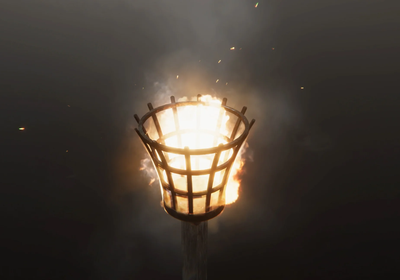
The beacon quickly took fire. And the sound of it: the steady roar of countless revolutionary voices.
The door of the tower was opened, and she ran towards me, her face ecstatic, her arms outreaching. She was beyond the power of speech and trembled in my close embrace.
Then we stared out into the darkness, the conflagration of the beacon to our backs.
Soon, perhaps ten miles away, another beacon sprang from unseen darkness to a fiery life: and beyond it another. Beyond that third beacon was a scarp, a ridge of low hills which might have had a name, but which name I did not know—this range of hills had the look of the edge of day: once beyond that folding of the earth there would never be the possibility of return—nor even the thought of a return—no words to express the idea—
Then, with a rapidity which denied belief, the remote beacon on that ridge took flame. Beyond that we could not see.

David Wheldon died in January 2021 at the age of seventy. He was born in 1950 in the mining village of Moira, Leicestershire. He graduated in medicine from Bristol University. He was the author of four novels, a short story collection, and several collections of poetry. A short story collection, The Guiltless Bystander, appeared posthumously in 2021. His two early novels were reissued by Valancourt USA in 2024.